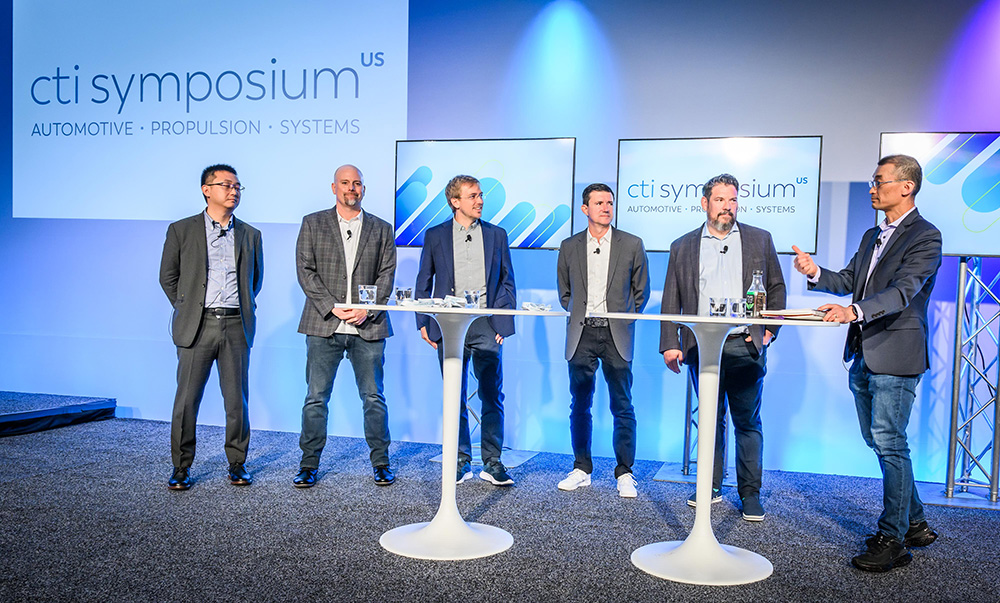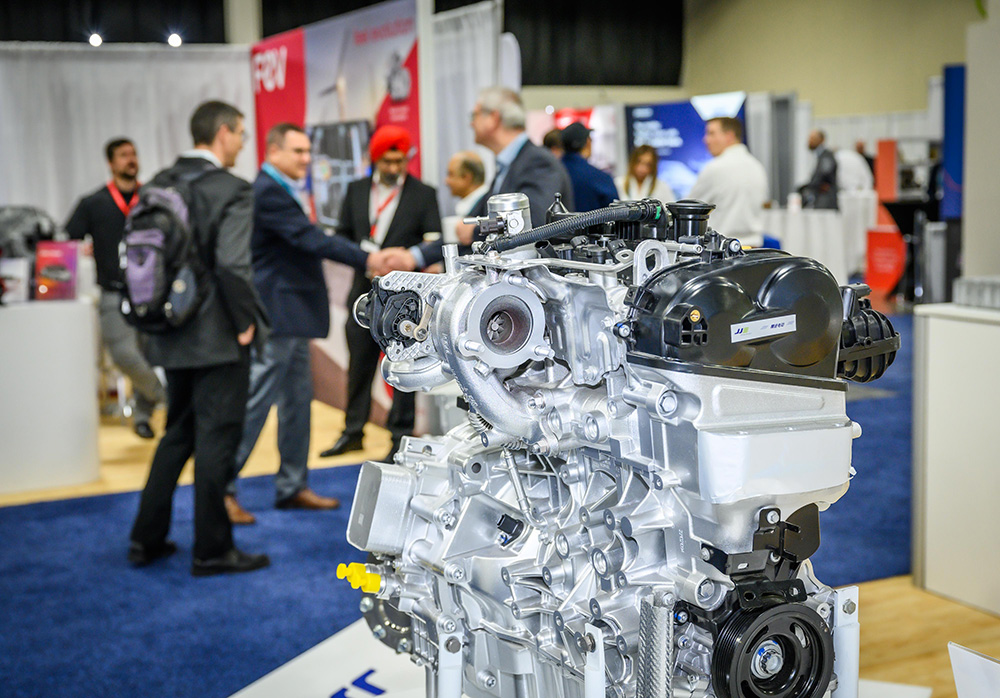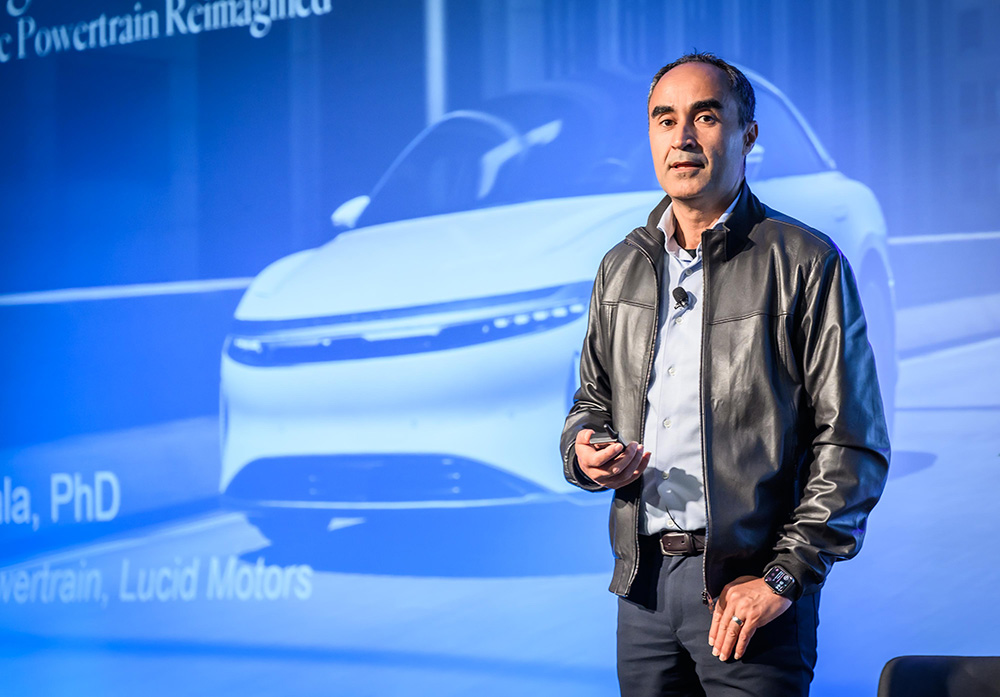

CTI SYMPOSIUM USA IS THE KEY MEETING POINT FOR GLOBAL FORWARD THINKERS IN AUTOMOTIVE POWERTRAIN DEVELOPMENT – FROM PASSENGER CARS TO HEAVY-DUTY VEHICLES.
Speakers

Micky BlySenior Vice President Propulsion Systems – Stellantis
Jordan ChobyGroup Vice President Powertrain Engineering – Toyota
Jon DarrowVice President of the North American Tech Center – Stellantis
Michael Dunne – Dunne Insights
Joe FadoolPresident & CEO – BorgWarner
Cassandra GarberChief Sustainability Officer – General Motors
Ingo ScholtenCTO – HORSE Powertrain
Luca ZampieriEngineering Director US – Neural Concept
The Expert Summit for a Sustainable Future Mobility
Only together we can create a sustainable future mobility. CO2 reduction is critical for automotive drivetrain. Here the battery electric drive using renewable energy is the focus. What can we do to increase efficiency and reliability, reduce cost and at the same time reduce the upstream CO2?
At CTI SYMPOSIUM the automotive industry discusses the challenges it faces and promising strategies. Latest solutions in the fields of electric drives, power electronics, battery systems, e-machines as well as the manufacturing of these components and supply chain improvements are presented. For the bigger picture market and consumer research results as well as infrastructure related topics supplement the exchange of expertise.
CTI SYMPOSIA drive the progress in individual and commercial automotive transportation. Manufacturer, suppliers and institutions are showing how to master the demanding challenges.
DISCUSSIONS
OEM Panel: The New Automotive Landscape
US Propulsion Strategy Post Regulation
Supplier Panel: Managing Through The New Global Automotive Landscape
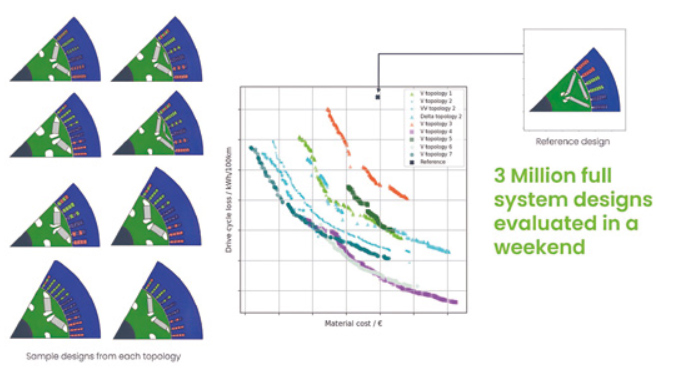
Intelligent Propulsion: How AI is Impacting the Design and Development of Automotive Propulsion Systems
SPECIALS
Accompanying Exhibition
Ride & Drive: Enjoy a full-feature tech experience in series and demo vehicles
Women@CTI Special Program
Start-up Area
Extensive networking opportunities
Outstanding evening event
NEW: Pre-Workshop Fundamentals and Best Practices of AI in the Powertrain and in Development
DEEP DIVE SESSIONS
Passenger Cars and Commercial Vehicles Powertrains
Hybrid and Electric Powertrains
Electric Motors and Power Electronics
Traction Batteries and Thermal Management
Virtual Development Processes and Cost Reduction
Markets, Policies and Supply Chains
Active Chassis (NEW!)
Advanced Analysis & Simulation
450+ INTERNATIONAL DELEGATES, EXHIBITORS & SPEAKERS
Geoff Lewis, Technical Director, Duvelco What is a New Material? Being ‘new’ is claimed with some regularity in the world of polymers; however, step changes in performance are less frequent. Here, I am going to look at an innovation that may pass the test and rightfully be called a new material. The polymer in question […]
Being ‘new’ is claimed with some regularity in the world of polymers; however, step changes in performance are less frequent. Here, I am going to look at an innovation that may pass the test and rightfully be called a new material. The polymer in question has the trade name Ducoya.
In terms of chemical type, it is a semicrystalline thermoplastic block copolymer bearing the unfamiliar name PMDA-ODA or, in long form, PyroMellitic DiAnhydride – 4,4‘-OxyDiAniline. The repeat unit is shown below:
This is a polyimide with an ‘I’; not a polyamide. Polyimides are a vast and rapidly growing class of polymers. The number of polyimide papers written annually has exploded in recent years. Polyimides include thermosets, thermoplastics, amorphous, semicrystalline, and photo-imageable materials.
The above graph shows the number of papers regarding polyimide. Source: Researchgate – Number of citations per year from 1975 to 2019, Web of Science.
Some may recognise this molecule as being from the 1960s; however, that is not the new part. This molecule, initially developed for NASA’s space programme, has long seemed too difficult to source and too expensive for many automotive applications.
This is especially the case as the industry moves into an era of cost-competitive BEVs, and, from a European and North American perspective, an era of low-cost, possibly subsidised Chinese BEV imports to compete with.
So, if it isn’t the molecule, what is new?
The innovation here is a new, patented manufacturing process that also covers the resulting material. Many high-performance plastics, including those produced by the traditional PMDA-ODA Manufacturing method, utilise monomers dissolved in harmful, high-VOC solvents. The environmental and high-cost considerations of these solvents mean they must be separated, distilled, and reused, consuming a large amount of energy in the process.
Ducoya avoids most volatile solvents used in the process and instead employs supercritical carbon dioxide and a catalyst.
Therefore, it is straightforward to separate the polymer from supercritical carbon dioxide by lowering the pressure. The carbon dioxide is repressurised and stored for reuse. This single step greatly streamlines manufacturing at scale, making the polymer considerably more accessible for automotive applications. However, this is not the end of the story. While the original aim of the invention was to simplify manufacturing at scale, when the properties of the resulting polymer were compared with those of its traditional predecessors, something remarkable emerged – dramatically improved mechanical and tribological properties.
The above graph consists of Ducoya preliminary data – arithmetic mean of five specimens, and best traditional values taken from published datasheets, none of which reported data over 260 °C.
The above graph consists of Ducoya preliminary data – arithmetic mean of thirty specimens, and best traditional values taken from published datasheets, none of which reported data over 260 °C.
Datasheet1
Ducoya G021 ISO is a filled version of Ducoya, containing 15 % wear- and friction-optimised graphite. Initial investigations of tribological properties in dry conditions indicate a significant improvement in wear factor compared to the best traditionally produced polyimides of this type. While much work remains to be done with this
specific molecule, this result seems to confirm earlier work by Irisawa et al. on several polymers, showing that the wear rate is inversely proportional to the product of tensile strength and elongation.
Of particular importance is the continued performance of this molecule at significantly elevated temperatures. This is because, when dry friction occurs – whether by design or due to off-design operation under adverse conditions – temperatures on the wear surface can rise substantially compared to the bulk material. For instance, regular operation at 120 °C can quickly lead to temperatures exceeding 240 °C on the wear surface under harsh sliding conditions (High PV value).
It should be noted that this general hypothesis applies only to materials of the same type (in this case, PMDA-ODA polyimides) and only when tested under identical conditions. Further work will determine whether this prediction holds for Ducoya G021 in comparison with other PMDA-ODA polyimide polymers.
Why would this be important to Battery Electric Vehicles?
As BEVs increase in torque, while package space and cost must decrease, this can lead to higher PV values as the available load area diminishes. This also reduces the weight of single-speed and multi-ratio transmissions. Epicyclic transmission layouts may particularly benefit from this improvement. Furthermore, Ducoya, being wear-resistant, although still relatively soft compared to metal, allows metallic debris, such as burrs and wear particles from gears, to embed in its material and be removed as contaminants from the lubricating oil. While this embedding must be limited, removing metallics before they can interfere with the proper functioning of the electric motor – often sharing the same lubricating oil as the transmission – can only be beneficial.
Conclusion
An interesting new material that adds a new dimension to accessibility and performance in automotive applications. Here, we have focused on mechanical and tribological properties.
Future Work
Future publications will describe why this unusual and newly applied process using supercritical carbon dioxide should lead to such improved mechanical and tribological performance.
Opportunities arising from the resulting electrical performance in conjunction with the latest high-precision
moulding techniques will be highlighted.
In addition, test results will be published in which the relationship between t·ε2 and wear rates in various
situations, as described above, will have been investigated.
1 DuPont Vespel® SP-21 ISO Reference No. VPE-A10863-00-B0614 published 2010 and 2021.
Kazuyoshi Hiraiwa, President, FINEMECH Shinji Morihiro, Representative, M Powerlabo Background of the proposal In recent years, the problem of BEV has become apparent, and the value of HEVs has been reevaluated. Under these circumstances, we would like to propose a next-generation HEV system. Purpose of the proposal This proposal is based on the THS (Toyota […]
Kazuyoshi Hiraiwa, President, FINEMECH Shinji Morihiro, Representative, M Powerlabo
Background of the proposal
In recent years, the problem of BEV has become apparent, and the value of HEVs has been reevaluated. Under these circumstances, we would like to propose a next-generation HEV system.
Purpose of the proposal
This proposal is based on the THS (Toyota Hybrid System). This is because the THS is superior to the series model in terms of power transmission efficiency as an E-CVT. The THS used in the Prius is simple system but it is generally said to have problems with starting acceleration performance and high-speed fuel economy. Looking at the specifications of the Prius, in order to ensure starting acceleration performance, the capacity of the MG2 (Motor Generator 2) for driving in recent models is larger than that of the initial model. However, the increased capacity of the MG2 makes to a deterioration in high-speed fuel economy. On the other hand, Toyota has added a four-speed automatic transmission planetary gear mechanism to the THS for LEXUS to improve both fuel efficiency and acceleration performance. However, this can only be applied to FR cars due to the axle length.
This proposal aims to improve fuel efficiency and acceleration performance by applying a dog-clutch parallel-shaft transmission mechanism to the THS, while also realizing a configuration that can be installed in FF vehicles. (see Figure 1)
Proposal Overview
The power transmission route between the ring gear and the output shaft of the planetary gear for torque division is the „mechanical route“ (M route), and the route that transmits power from the sun gear to the output shaft via MG1 and MG2 is the „electric route (E route)”. If the route between the input shaft and the output shaft is a „direct connection route (D route)”, a dog clutch type transmission mechanism is provided for each route (see Fig. 2). That is, there are only three sleeves. Normally, both the M route and the E route are transmitted as an E-CVT, but when switching from H-1 to H-4, which will be described later, the gear is shifted through the D route to avoid loss of output shaft torque when driving on one route while driving on the other route, and when shifting under high load.
MG capacity (at ICE power 1) is assumed as follows: This takes into account that if the input shaft is fixed and used as a PHEV, the driving force equivalent to that of an ICE can be obtained. Also, the specs of the early PRIUS were almost this ratio.
MG1 0.4
MG2 0.6
Basic rule of Sleeve switching (Dog clutch)
Torque is set to 0 and the engagement is related, and the engagement is carried out with a speed difference of 50rpm or less.
Operation
First, we will explain the shifting operation of the E-CVT in HV mode. If the sleeves are S1, S2, and S3, then the H-1 is a combination of the M route (S1) and the E route (S2) with Lm and Le. Switching from H-1 to H-2 is done as follows: When driving on Lm on the M route, the MG2 torque is reduced to zero at the mechanical point (when MG1 stops), making it easier to switch the E route from Le to Me, and the output torque can be shifted without change. That is, the switching from H-1 to H-2 is carried out with gear ratios near the mechanical point of H-1.
Also, switching between H-2 and H-3 is done through the D-route Ld (D-1). In other words, if the gear ratio is equal to the value of Ld while driving in H-2, the speed of the S3 and the opponent’s gear matches, so it is easy to shift S3 and switch to D-1 at this point. S1 and S2 can be freely operated while driving in D-1, so if you revive the power generation of MG1 and the drive of MG2 by connecting H-3 in the operation chart, it will switch to H-3. This can also be done without any change in output torque.
Similarly, it is easy to switch from H-2 to H-4 via D-3. You can switch in the same way in these reverse orders.
In addition, the above switching is done with a fixed gear ratio, but especially in low to medium load driving, it is possible to switch without the drive of the D-route in any gear ratio. This means that you can drive on one route, M route and E route, while switching between the other. In this way, in low- to mediumload driving, it is possible to switch between any gear ratio without little change in output torque.
Kickdown
If you press the throttle pedal sharply while cruising on the H-3, follow these steps:
When the ICE power is increased and the gear ratio is equal to the value of D-1, switch S3 to Ld (D-1) and operate S1 and S2 to switch to the desired drive mode while driving with D-1.
If you press the throttle pedal sharply while cruising on the H-4, follow these steps:
When the ICE power is increased and the gear ratio is equal to the value of D-2, switch the S3 to Hd (D-2), and operate the S1 and S2 to switch to the desired drive mode while driving with D-2.
Of course, if the amount of throttle pedal depression is not very large, you can switch at any gear ratio by switching while driving on either the M route or the E route mentioned above.
MG1 & MG2 Stops
It is widely known that power loss due to dragging torque of MG1 and MG2 occurs when the ICE stops at medium or high speeds, or when MG2 is driven at low load at high speeds. The system allows MG1 and MG2 to be stopped as needed. (See Figure 5)
This means that if the ICE stops while driving at medium to high speeds, you can stop MG1 by putting S1 in neutral. If you want to revive the connection of MG1, rotate MG1 to synchronize and shift S1 again. In addition, the gear ratio near the mechanical point of the H-4 and the low-load high-speed driving on the D-1 and D-2 can keep the MG2 at a standstill if the S2 is neutral. This avoids loss of drag torque and improves fuel economy.
Application to PHEV
As is well known, PHEV is established by increasing the battery capacity and providing a means to fix the input axis, allowing MG1 to participate in driving in addition to MG2 in EV mode. In this case, by driving one of the M routes and the E route while switching between the other using the same method as above, you can switch between EV mode while preventing loss of output torque. This means that it is possible to smoothly switch between the MG2’s three-stage drive and the MG1’s two-stage drive without losing drive torque. Of course, this is when switching, not to mention that after the switch is complete, you can drive both MG2 and MG1, or even one of them. It can also be driven by stopping one side, allowing for a variety of drives.
Advantages of this system
The multi-stage THS reduces the capacity of the MG2 while ensuring acceleration performance in the low speed range and driving torque during reverse driving.
In HV mode, the drive mode can be switched without changing the output torque. Moreover, in medium and low load driving, it can be switched with any gear ratio.
No oil pump or friction clutch required.
MG2 and MG1 can be stopped when it is not needed.
By reducing the size and stopping of the MG2, fuel efficiency can be improved by about 6 ~ 8 % during high-speed cruising.
When applied to a PHEV, it makes EV mode driving in multiple modes to achieve smooth shifting.
While having the above functions, it fits into a size that can be installed on an FF car.
When compared to the THS+4AT and Renault systems, we can see that this system has many advantages. (See Figure 6).
References
TOYOTA Hybrid System, Development of Multi Stage Hybrid Transmission , K. Okuda, Y. Yasuda, M. Adachi, A. Tabata, H., Suzuki, K. Takagi(Toyota), T. Atarashi, R. Horie (Aisin AW), 2017 SAE World Congress, No.2017-01-1156 (2017/4/4-6)
Renault HEV System, The new DHT from Alliance Renault/Nissan, Antoine Vignon (Renault FRANCE), CTI Symposium 2017 Berlin
Dr-Ing. Philippe Farah, CEO – Founder YEESMA SARL Dr-Ing. Shafigh Nategh, CTO – Founder, YEESMA SARL Yu-Chi Tsai, Business Development & Marketing, YEESMA SARL Electrically Excited Synchronous Machines (EESM) is one of the strong candidates to solve the supply chain risks, costs and sustainability issues due to the Rare-Earth magnets presently used in almost 90 […]
Dr-Ing. Philippe Farah, CEO – Founder YEESMA SARL Dr-Ing. Shafigh Nategh, CTO – Founder, YEESMA SARL Yu-Chi Tsai, Business Development & Marketing, YEESMA SARL
Electrically Excited Synchronous Machines (EESM) is one of the strong candidates to solve the supply chain risks, costs and sustainability issues due to the Rare-Earth magnets presently used in almost 90 % of the Traction Motors. However, for long, EESM presented lower Performances, especially in terms of Torque density: approximately 10 to 20 % bigger volume required combined with Lower Efficiency (down to 3 %) compared to Radial Flux Interior Permanent Magnets Solutions considered as today’s Benchmark.
Introduction and Objectives:
YEESMA combined 2 major concepts into what’s called YEESMA that stands for Yokeless (Yoked) Electrically Excited Synchronous Machines. This Proprietary solution consists of an Axial Flux AND Electrically Excited Topology. Preferred topology is a Dual Rotor, Single Stator that helps solving the Packaging and Performances challenges: up to 20 % Torque volumetric density, with more than 60 % Bill Of Material (BOM) cost reduction AND 60 % Higher Sustainability Index.
Figure 1: Topologies Comparison
Inverter Phase current is also significantly reduced thank to a Unity Power Factor and participates to the 60 % Cost reduction mentioned above.
YEESMA Technology
YEESMA solution is an Axial Flux based topology. Preferred solution is typical Single Wound-Stator sandwiched between 2 Wound-Field Rotors. Note that intrinsic to Axial Flux, inner diameter areas being “empty”, YEESMA can incorporate there both Position Sensor and Rotor Power Supply (being Brush type, or Brushless Inductive Transformer).
Figure 2: YEESMA Technology
Development Methodology
YEESMA developed their own FEA & Optimization models to reduce development time while still keeping “Digital-Twin” approach: Define at best all requirements’ details, from Performances outputs through Environment Specifications, like e.g. Air Cooling requirements for a 2-Wheelers or Oil-cooling specifications for a Truck Application. Our Approach heavily relies on conducting thorough Simulation Analysis before building Hardware parts. Such optimization process through a 3D-FEA Electromagnetic analysis is shown hereafter:
Figure 3: Optimization Process
The genetic algorithm progressively concentrates the population of candidate designs in the performance-optimal region of the search space.
Case Studies Results
Several Case Studies were conducted following same “Digital Twin” process. For simplicity and confidentiality reasons, only 4 cases studies are presented here.
For each case, we used CO2 footprint as a Sustainably Quantifier. This is done through summing up for each design material amount (active parts only), mostly Steel, Copper or Aluminum, and rare-earth permanent magnets for Benchmarks solutions.
Figure 4: YEESMA Case Studies Results
Proof Of Concept Experimental Results
To further validate all our design tools, YEESMA designed, built and tested its own Proof Of Concept Hardware [1] – [2]. This has been done through the Department of Engineering “Enzo Ferrari”, University of Modena and Reggio Emilia (Italy).
Picture hereafter shows (manually) wound rotor.
Figure 5: YEESMA Wound-Rotor
Whole tests were conducted on a dynamometer setup, with an external drive capable to provide both Stator Armature AC currents and Rotor field DC current.
Thorough analysis was done at first at no-load comparing theoretical BACK-EMF and measured voltages at various excitations levels. Exceptional confirmation was obtained through the whole excitation current range. Figure below measured data at 2000 rpm and 6.0A (considered as nominal excitation current)
Figure 6: Comparison between Measured and Simulated Back-EMF
Load-tests focused first in the Continuous Torque/Speed area and shows as well very good fit between FEA Simulation and Experimental Results. Less than 5 % difference can be reported up to 1.6 times Maximum Continuous Torque
Figure 7: Comparison between Measured and Simulated Torque
Conclusion
This study has presented the Yokeless Electrically Excited Synchronous Machine (YEESMA) as a viable, high-performance, and sustainable alternative to conventional rare-earth permanent magnet machines. By eliminating the need for rare-earth materials and transitioning from a radial flux to an axial flux configuration, the YEESMA topology achieves significant reductions in copper usage, weight, and raw material demand, while maintaining competitive torque and power density. In addition, the proposed design achieved close to unity-power factor, it significantly reduces Inverter current demands and participates to the Overall Cost reduction.
Further development work will focus on the Manufacturing axis with Production-intend designs developed with an Industrial Partner.
References
[1] V. Mangeruga, A. Piergiacomi, S. Nategh, P. Farah and S. Nuzzo, „Structural Investigations on Yokeless Electrically-Excited Segmented Armature Axial Flux Motor,“ 2025 IEEE Workshop on Electrical Machines Design, Control and Diagnosis
(WEMDCD), Valletta, Malta, 2025, pp. 1 – 6
[2] Design Optimization and Experimental Validation of an Innovative and Sustainable Electric Machine Topology,“ in IEEE Transactions on Transportation Electrification, Oct. 2025. (Submitted)