
Automotive drivetrain engineers aim to perfect and refine electric drive lines to the point where they operate right at the edge of what is physically possible. This requires simulation models, to act as cost function in the design process or to train reduced order models. These latter models should incorporate all physical loss and performance mechanisms and should be computationally efficient at the same time. Often however, important contributions to efficiency or performance drops are hidden in empirical build factors. These factors can only be quantified too late in the design process, i.e. after testing of the first prototypes.
Based on our experience we developed Taurus, a simulation tool chain that uses industry standard tools, but adds the necessary embedded experience to capture detailed impact from component level, all the way up to the drivetrain level.
Use case: Taurus eliminates the use of build-factors for motor loss prediction
Detailed modelling in Taurus allows to calculate in a computationally efficient way the loss contributions in the motor induced by manufacturing effects and high-frequency operation. This includes degraded material properties at the cutting edges and mechanical pressure for the manufacturing effects. PWM switching induced losses in the magnets, copper, and iron are also calculated. Figure 1 illustrates the delta in amount of losses and their spatial distribution by including these effects. Prior to the calculations, additional material characterizations have been carried out.
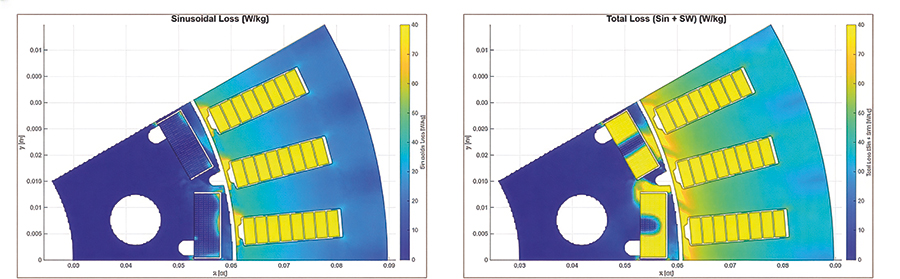
Figure 1: ignoring PWM-induced losses and manufacturing effects leads to incorrect loss distribution data.
This spatial loss information is calculated for all operating points and thus allows further detailed analysis utilizing the data in time-based simulations to identify hot spots or to calculate cycle consumption for the full driveline.
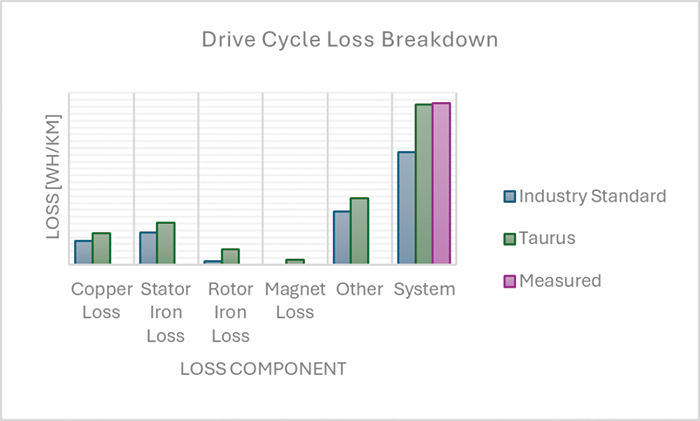
Figure 2: Cycle loss breakdown: industry standard tool (build-factors) vs. Taurus (first principles).
The net effect of this increased fidelity on a drive cycle consumption is visible in Figure 2. It compares the loss predictions from an industry standard tool (using build factors) with the first-principles approach from Taurus and shows the correlation with measurements.
Conclusion
With limited additional characterization, a detailed and computationally efficient calculation allows to optimize cycle consumption and avoid local hot spots. By adhering to two main principles: leveraging industry standard tools and including loss mechanisms on a first principles basis, Taurus enables fast driveline R&D support from concept to troubleshooting.
Introducing DRV Solutions
DRV Solutions is an engineering partner for advanced electric drive lines, supporting from concept to validation. We combine motor & power electronics design, full driveline analysis, and system integration expertise in our Taurus Toolkit. This enables us to accelerate your design and troubleshoot performance issues.