Florian Bosler, Vice President Business Development and R&D Sealing Solutions & Engineered Metal Components, ElringKlinger AG
As e-motors become more power-dense, thermal management is emerging as a critical design challenge. At CTI Berlin, discover how MetaloBond™ full-face bonding technology enables leakage-free direct cooling, combining sealing performance, structural integrity, and scalable manufacturing in a single solution.
MetaloBond™: unlocking the next generation of direct-cooled electric motors
Electrification is driving the development of increasingly power-dense electric motors. Higher power output from smaller package volumes improves vehicle performance and system efficiency, but it also intensifies thermal loads within rotor and stator assemblies. As a result, direct cooling strategies are becoming an important design approach for managing local hot spots and maintaining thermal stability.
Direct oil cooling enables coolant flow close to regions of highest heat generation. Compared with conventional indirect cooling approaches, this can improve heat dissipation and support higher motor output. However, introducing coolant directly into laminated core structures creates a significant engineering challenge: preventing leakage between individual laminations.
Coolant migration through lamination interfaces can allow oil to enter unintended areas, including the air gap between rotor and stator. Such leakage may lead to drag losses, reduced efficiency, and compromised cooling system performance. In addition, sealing solutions must withstand operational pressure loads, temperature exposure, and long service life requirements while maintaining the mechanical integrity of the laminated stack.
A further challenge is that conventional sealing approaches may require additional components or design compromises. Consequently, there is growing interest in technologies that combine structural bonding and sealing functionality within the lamination stack itself.
Full-face bonding as a sealing concept
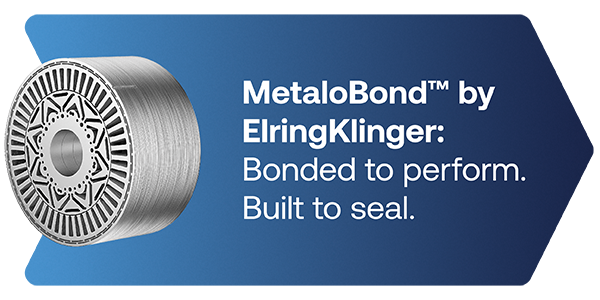
MetaloBond™ is a full-face adhesive bonding technology developed for rotor and stator laminations. The concept uses a continuous adhesive layer applied across the entire lamination surface, creating both mechanical bonding and a sealing barrier between individual laminations. The technology is integrated into an established coating process and can be adapted to additional application-specific requirements through adhesive formulation selection.
Unlike localized bonding concepts, a full-surface approach distributes loads across the entire interface while simultaneously providing a continuous sealing function. This enables direct cooling architectures without the need for separate sealing elements between laminations. The technology can support cooling concepts in which coolant is routed close to thermal hot spots, including in-slot cooling arrangements and other directly cooled stator and rotor designs.
Validation Methodology
To evaluate sealing performance, leakage testing was conducted on bonded laminate specimens without axial compression of the stack, representing a demanding validation condition. Test specimens included sealing land widths of 0.7 mm, 1.0 mm, 1.5 mm, and 15 mm. Compressed air testing was performed at pressures up to 5 bar, while hydraulic oil testing was carried out at pressures up to 200 bar.
In addition to static leakage assessment, dynamic durability testing and thermal aging investigations were conducted to evaluate long-term sealing reliability under representative operating conditions.
Sealing performance results
Across all tested sealing land widths and stack thicknesses, no leakage was detected during compressed air testing up to 5 bar. Similarly, hydraulic oil testing up to 200 bar showed no measurable leakage for specimens with sealing widths of 0.7 mm, 1.0 mm, 1.5 mm, and 15 mm. These results indicate robust sealing performance even for narrow sealing geometries.
Dynamic validation was performed using oil as the test medium with cyclic pressure loading between 0 and 20 bar at a frequency of 20 Hz. After one million cycles, leakage remained at zero. Additional validation following oil exposure at 150°C for 1,000 hours also demonstrated zero leakage under the same dynamic loading conditions.
To further assess endurance limits, testing was continued under dynamic pressure loading until failure. The evaluation was terminated after 1.4 million cycles at 110°C without any detectable leakage.
Mechanical integrity and material performance
For direct cooling applications, sealing performance alone is insufficient. The bonding layer must also provide durable mechanical strength to withstand manufacturing, handling, and high-speed motor operation.
Material validation according to EN 1464 showed a roll peel strength of 3.4 N/mm in the as-manufactured condition. After thermal aging at 180°C for 1,000 hours, the measured value increased slightly to 3.5 N/mm. Tensile lap shear testing according to EN 1465 produced a value of 22 N/mm² in the new condition and 21 N/mm² after thermal aging for 1,000 hours at 180°C.
The results indicate that the bonded interface retains its structural capability following extended thermal exposure, supporting the combined requirements of sealing and mechanical robustness within demanding e-motor environments.
Application validation in direct-cooled e-motors
The technology has been evaluated across multiple cooling architectures. Examples include stators with more than 100 cooling channels and complex geometries, in-slot cooling concepts with sealing lands as small as 0.5 mm, direct cooling systems in which coolant is routed through the stator and sprayed onto the windings, housing-free stator concepts integrating structural and cooling functions, and directly cooled rotor applications. Both extra-low-viscosity oils and water-glycol coolants have been considered, with operating pressures ranging from approximately 1.4 bar to 80 bar depending on the application.
These examples illustrate the broad range of cooling architectures for which lamination sealing has become a critical design requirement.
Manufacturing and industrialization
From an industrialization perspective, the bonding process is based on established manufacturing operations including coating, slitting, stamping, assembly, and inspection. This enables integration into high-volume production environments while leveraging proven process technologies.
A current serial production launch demonstrates the scalability of the concept. The program involves approximately 120,000 laminated stacks per year for a direct-cooled application featuring more than 100 cooling channels and a pressurized cooling medium operating at 3.5 bar. Production is supported by a fully automated manufacturing line with integrated end-of-line testing.
Conclusion
As electric motors continue to evolve toward higher power densities, direct cooling is becoming an increasingly important enabler of thermal performance. At the same time, effective sealing of lamination interfaces is emerging as a critical requirement for successful implementation of these cooling architectures.
Validation results demonstrate that full-face bonding technology can provide leakage-free sealing under pressures up to 200 bar, withstand dynamic loading beyond one million cycles, and maintain mechanical strength following long-term thermal aging. These characteristics indicate that full-surface bonding approaches can simultaneously address coolant containment, structural integrity, and manufacturing scalability, supporting the next generation of directly cooled electric motor designs.