Ivan Jovanovic, Team Leader Incubation InnoHub
Cost optimization in modern drivetrain systems requires more than benchmarking—it demands structured, data driven ideation. This article presents an AI supported methodology that leverages largescale teardown intelligence to systematically generate and assess cost measures at component and system level. The approach bridges the gap between engineering detail and cost strategy decision-making.
Introduction
Automotive drivetrain systems are undergoing rapid transformation driven by electrification, increasing system complexity, and mounting cost pressure. Engineering teams are expected to identify cost reduction opportunities earlier and with greater confidence, while preserving performance, quality, and compliance. Traditional cost
engineering approaches—often based on expert workshops, static benchmarks, or manual analysis—struggle to scale with the growing volume and complexity of available technical data.
This article presents a structured, data driven approach for generating cost measures for systems using largescale teardown intelligence combined with AI supported analysis. The methodology is designed to support engineers and cost analysts in identifying, structuring, and prioritizing cost measures based on factual technical evidence rather than assumptions or isolated examples.
Technical Challenge
Teardown databases today contain thousands of components, materials, manufacturing processes, and architectural design choices across vehicle generations and OEMs. While this data provides a rich foundation for cost insights, extracting actionable cost measures remains challenging due to:
- High data volume and heterogeneity
- Limited traceability between design choices and cost impact
- Dependence on individual expertise to formulate improvement ideas
- Difficulty comparing alternative technical solutions at scale
As drivetrain architectures evolve—especially in electrified powertrains—there is a growing need for systematic methods that transform teardown data into concrete, reusable cost measures.
Methodology
The presented approach is based on three core technical pillars:
- Structured Teardown Intelligence Componentlevel teardown data is normalized across materials, geometries, manufacturing processes, and system architectures. This enables cross vehicle and cross-generation comparisons within subsystems.
- Cost Measure Pattern Identification Historical teardown data is analyzed to identify recurring cost relevant design patterns, such as material substitutions, part integration, geometry changes, or process shifts. These patterns are abstracted into reusable cost measure templates that are independent of a single vehicle or OEM.
- AI Supported Ideation and Filtering An AI based engine combines teardown evidence, cost drivers, and engineering constraints to generate potential cost measures. Measures are contextualized by vehicle segment, drivetrain type, and system boundaries, allowing relevance filtering and prioritization based on feasibility and expected impact.
Concrete Example: Evidence Based Part Elimination
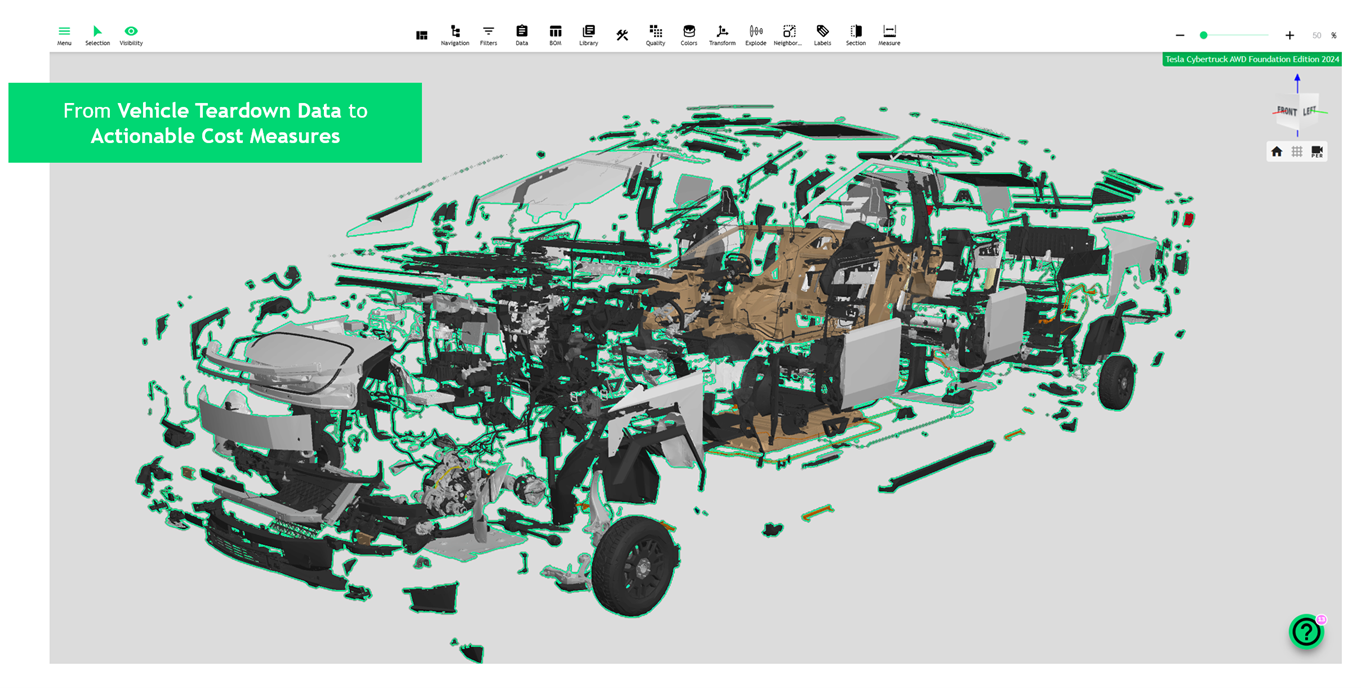
Teardown analysis reveals that the removal of the external brand logo on the hood—first observed on the Tesla Cybertruck and later adopted on recent Model Y versions—constitutes a validated example of part elimination for cost optimization. This decision removes a complete component and associated assembly steps, improving manufacturing efficiency and reducing part count. Such ground truth examples enable data driven challenges to traditional design choices, while highlighting that radical cost measures often require longer internal alignment despite their technical simplicity.
Achieved Innovation
The key innovation lies in shifting cost measure generation from an experience driven activity to a repeatable, data supported process. Instead of manually deriving ideas from individual benchmarks, engineers can explore a structured set of cost measures grounded in real, observed design solutions.
For drivetrain systems, this enables:
- Faster identification of technically realistic cost measures
- Improved transparency between design decisions and cost impact
- Better reuse of historical teardown learnings across projects
- Support for early phase concept and target setting activities
The approach does not replace engineering judgment; rather, it augments it by providing a technically substantiated starting point for cost discussions and design trade-offs.
Conclusion
As drivetrain technologies continue to evolve, cost engineering must evolve in parallel. Leveraging teardown intelligence through structured data models and AI supported ideation offers a scalable way to generate high-quality cost measures rooted in real engineering solutions. This methodology supports more informed, fact-based decisionmaking and helps bridge the gap between technical design and cost strategy in modern automotive development.