
Dr. Cao Yang, Engineering Executive, Company: JJE Technologies Co.,Ltd
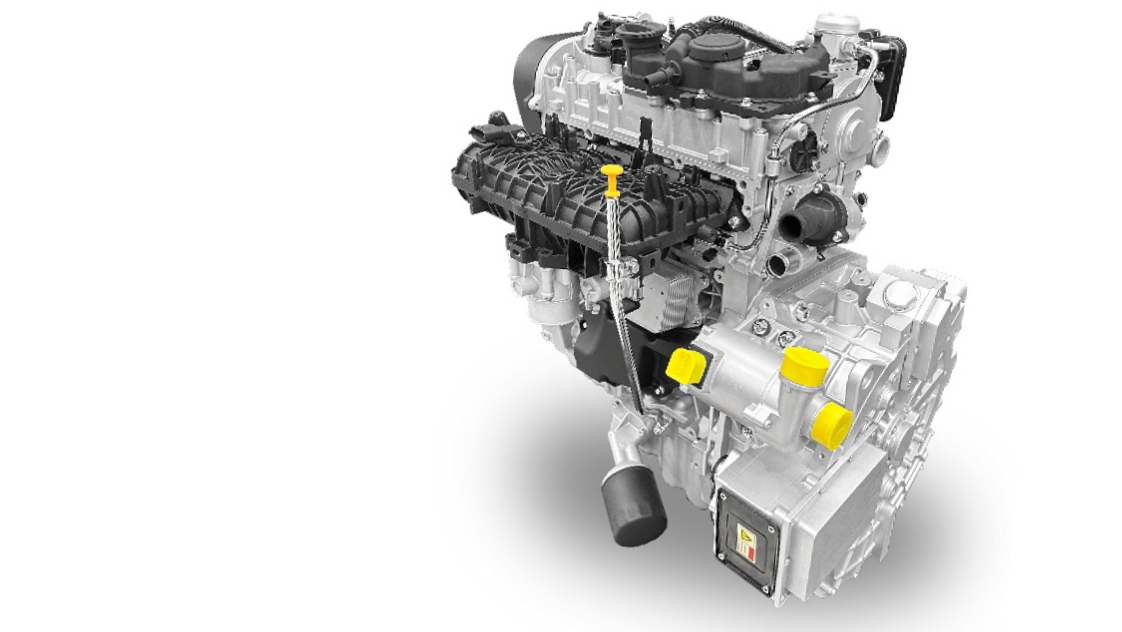
The range extender, as a critical enabler for new energy vehicles, has long been challenged by the inherent trade-off between compactness, noise, vibration, and harshness (NVH), and system cost. This article presents JJE’s Integrated Active Cancellation Range Extender Technology, a next-generation system that fundamentally redefines the mechanical and control architecture of hybrid power units.
The technology is built upon three core innovations:
- direct-coupled, oil-cooled coaxial architecture that eliminates the flywheel and all torsional damping elements;
- an active torsional vibration cancellation strategy that generates an opposing torque wave relative to the generator torque profile to neutralize engine vibration;
- a novel method for determining engine crankshaft position using the motor resolver signal without additional sensors.
Together, these innovations enable a system in which speed fluctuation is reduced by over 50% and body vibration by more than 85%, while achieving unprecedented mechanical simplicity and robustness validated in full-scale mass production. This paper details the design philosophy, implementation, and performance validation of the JJE range extender, establishing it as a benchmark for future integrated hybrid powertrains.
Introduction
Conventional range extenders inherit the complex architecture of traditional internal combustion engines, including flywheels, torsional dampers, and numerous sensors and communication networks, to manage noise and vibration. These components add weight, cost, and packaging complexity, while noise and vibration still compromise passenger comfort when the engine switches between operating points.
Moreover, delays inherent in conventional speed sensors and communication buses limit the effectiveness of vibration cancellation strategies, preventing precise tracking of the generator’s vibration waveform. After more than a decade of development, JJE has overcome these limitations by introducing a fully integrated range extender—a step-change innovation. The concept combines deep mechanical integration with intelligent active control. The result is a system in which the engine crankshaft, generator rotor, and oil pump rotor are rigidly connected along a common axis, allowing the generator to act as an active actuator that cancels vibration at its source—the internal combustion engine.
Direct-Coupled Coaxial Architecture
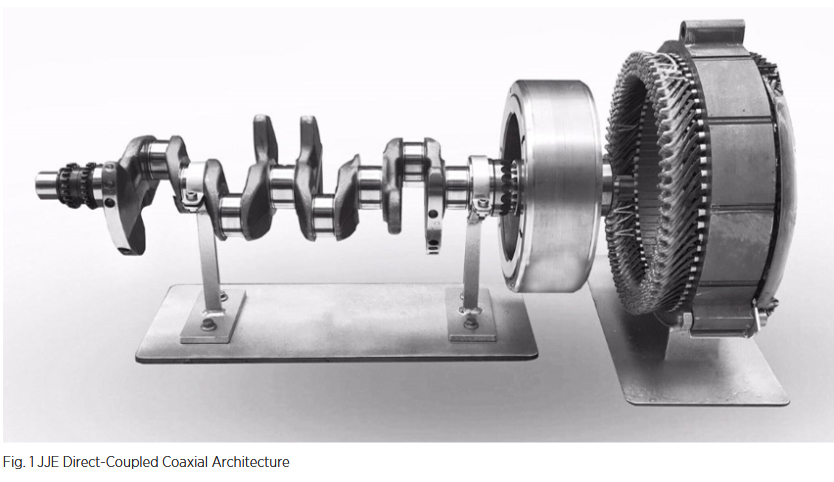
The first innovation is the system’s mechanical design: a rigid coaxial connection between the engine crankshaft, generator rotor, and oil pump rotor, without any flywheel or torsional damping elements (Fig. 1). In conventional designs, flywheels and torsional dampers are used to smooth engine torque before it reaches the generator. However, these components add rotational inertia, reduce dynamic response, increase axial length and system weight, and introduce wear-prone elements.
In JJE’s architecture, these components are intentionally eliminated. The crankshaft output flange is directly coupled to the motor shaft, with the oil pump rotor mounted at the rear. The entire rotating assembly behaves as a single rigid body with minimized moment of inertia. As a result, the system achieves a weight reduction of approximately 11 kg and a significant cost reduction. The removal of flywheel and damping elements introduces an NVH challenge: engine torque pulsations act directly on the generator rotor. This is addressed by the second innovation—the active control strategy.
Active Torsional Vibration Cancellation (ATVC)
The rigid, low-inertia architecture is made feasible by the development of active torsional vibration cancellation (ATVC). The core concept is to treat the generator not only as an electrical load, but also as a torque actuator capable of producing a precisely controlled counteracting torque waveform.
JJE’s system implements an active control algorithm (Fig. 2). Using real-time crankshaft position data, the controller predicts the engine’s instantaneous torque contributions. Based on this prediction, an opposing torque waveform is synthesized and superimposed onto the generator output torque. This effectively creates a virtual torsional damper with zero mass and no mechanical wear.
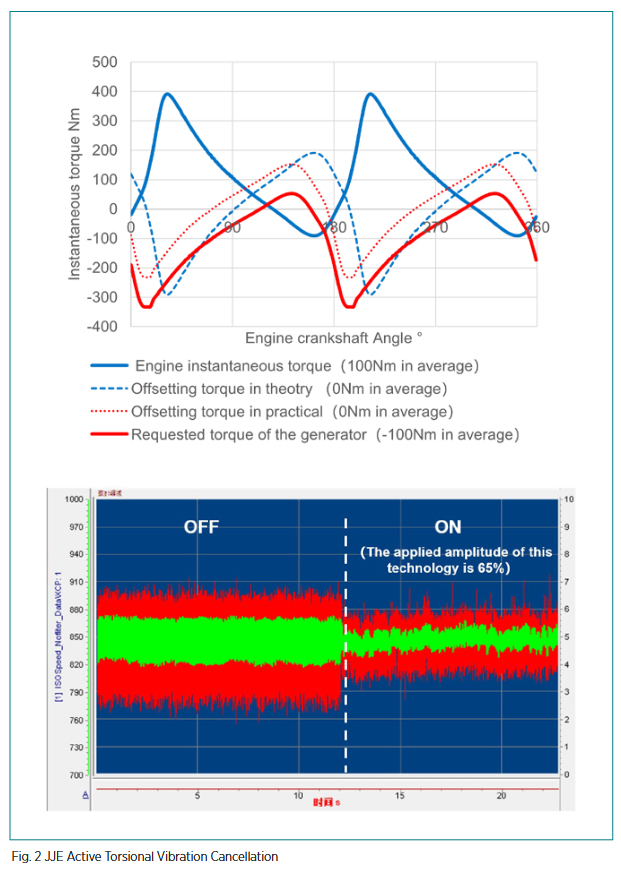
The system reduces speed fluctuation by more than 50% compared to a passive damping solution. More importantly, vibration transmitted to the vehicle body is reduced by over 85%, delivering a substantial improvement in NVH performance.
Engine Crankshaft Position Detection via Motor Resolver
High-performance vibration cancellation depends on accurate, zerodelay measurement of crankshaft position. This innovation eliminates the need for conventional engine position sensors entirely. In JJE’s system, the motor rotor is rigidly coupled to the engine crankshaft, meaning both rotate at the same speed. The motor resolver inherently provides precise rotor angular position, which directly corresponds to the crankshaft position.
A dedicated method was developed to derive crankshaft position from the resolver’s raw sine and cosine signals at high refresh rates within the generator controller. During the first engine cycle after start-up, a calibration algorithm identifies piston positions by analyzing resolver signals in combination with the known engine firing order. Once synchronized, the resolver-derived angle is distributed within the controller with effectively zero delay, meeting the stringent requirements of the cancellation algorithm.
This approach eliminates the need for crankshaft position sensors, associated wiring, connectors, and signal conditioning circuits, improving system robustness while reducing cost and complexity. The solution has been fully validated in mass production.
System Integration and Production Validation
This system has been deployed in multiple mass-production vehicles, including the Beijing Auto BJ40E and BJ60E. Notably, the BJ40E has become one of the best-selling off-road SUVs in the Chinese market since its launch in April 2025.
Conclusions
JJE’s Integrated Active Cancellation Range Extender Technology represents a significant breakthrough in range extender design. By combining a directconnected architecture, active torsional vibration cancellation, and sensorless crankshaft position detection, JJE has created a system that is mechanically simpler, more compact, and substantially superior in NVH performance compared to conventional solutions.
With robustness proven in mass production, this integrated system is well positioned to enable the next generation of quiet, efficient, and cost-effective hybrid and range-extended vehicles.