Dr. Reik Laubenstein, Engineer, IAV Automotive Engineering Inc.
Dr. Johannes Werfel, Team Manager, IAV GmbH
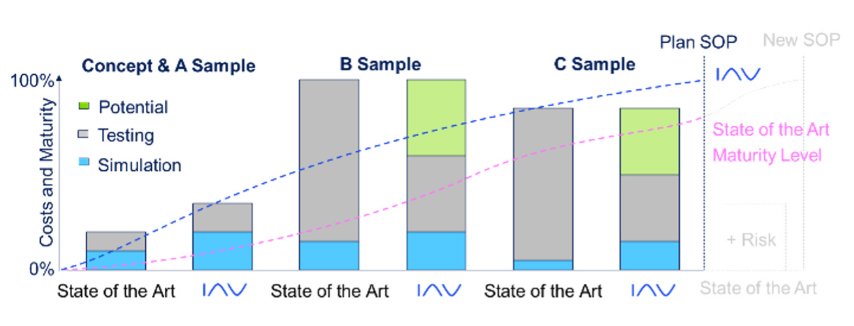
Batteries are the core component of electrified vehicles. However, conventional approaches, that heavily rely on physical prototyping and extensive testing, are too slow and costly for the pace that is demanded by the market. IAV implemented virtualdriven processes with smart testing achieving development time and cost reductions of up to 30 %.
Methodology
Often the development of EV batteries heavily relies on continuous and frequent hardware updates and extensive durability testing that proves challenging considering timelines and associated costs. Main obstacles are scarce component availability (e.g., cells) in early stages, and expensive & time-consuming testing loops. Shifting towards virtual development can mitigate these challenges, but these methods often fall short on capturing the complex interactions between the different domains (design, thermal management, function). However, IAV developed a project-proven methodology that focuses on early application of predictive component models, which can be coupled and used to predict the behavior of the higher-level system with complex interactions (e.g., module or pack, see Fig. 1) und thus, reduce expensive prototyping and testing during. The foundation of this “shift-left” approach are electro-physico-chemical models (EPCM) that describe the electrical, thermal and mechanical behavior of the cell. Due to the scarcity of physical cells at early stages of development, our internal tools and workflows enable deriving theoretical cell design parameters with minimal input to construct baseline cell models, that are continuously optimized with further progress. To further increase efficiency, we established a smart testing approach based on reinforcement learning to characterize cells in early stages, by utilizing neural networks to balance the testing effort and model accuracy. It has been shown that 60% of all relevant operational points can be sufficient to reach a comparable accuracy of a model that utilizes all measurement points of the measurement matrix. Once established, the EPCM can be seamlessly integrated into the aforementioned domains to enable further development and optimizations by the respective domain experts. This is realized via the versatile virtual battery testbench (VBT) framework developed by IAV and allows for model-in-the-loop (MiL) investigations in various other established toolchains, which are being utilized by various domain experts throughout the whole V-process (e.g., thermal management, BMS function development, exploration of mechanical constraints) and without requiring physical cell samples.
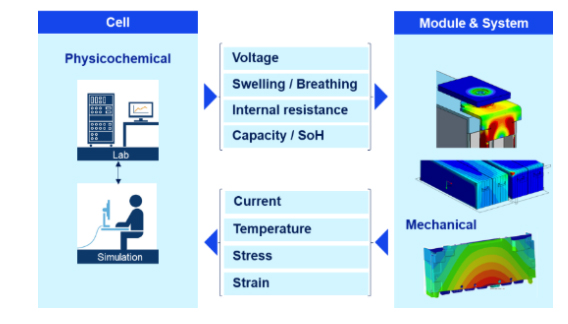
Figure 1
Application
A critical aspect in battery systems development is the ability to accurately understand and predict battery aging under realistic operating scenarios. In our approach the EPCMs are capturing structural changes on particle level (e.g., Li plating, SEI growth, particle cracking) in response to the change of the boundary conditions of the system via interaction through the VBT. This was applied in a representative project: failures in battery modules were detected at roughly half the targeted lifetime. A simulation-driven approach utilizing the cell model, completed within six weeks identified critical pressure accumulation caused by the interaction of cell aging, swelling, and module boundary conditions. Early virtual integration is estimated to have saved more than six months of testing and prototyping.