
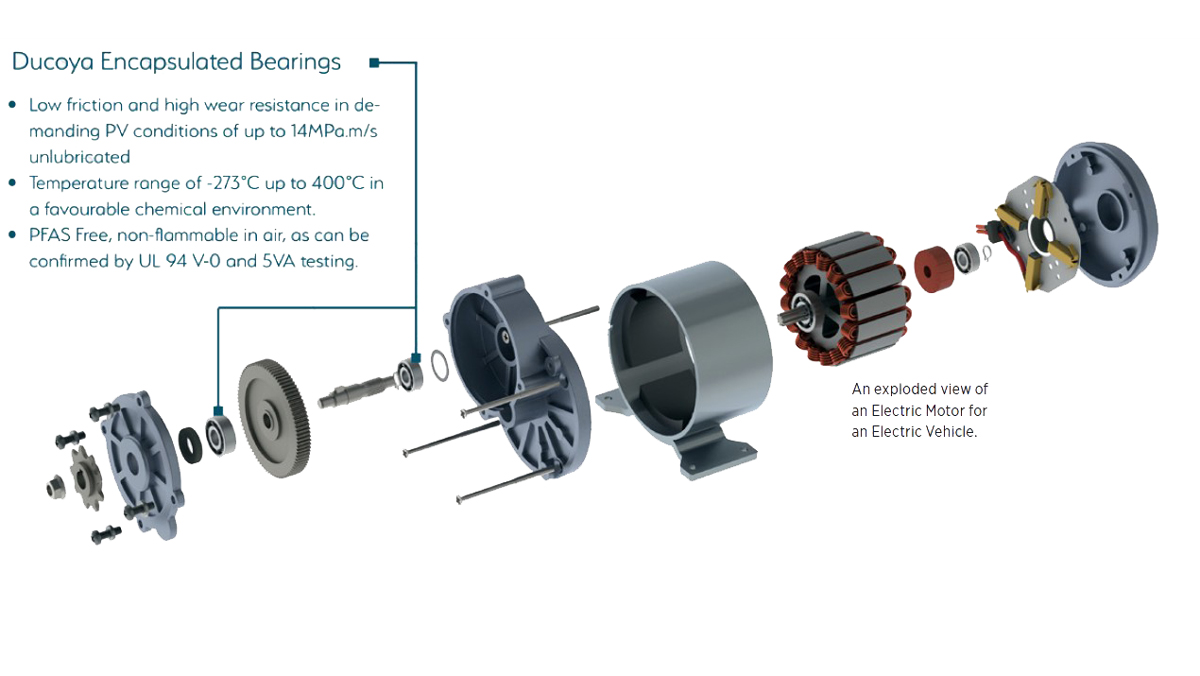
Goeff Lewis, Technical Director, Duvelco
OEMs love SiC and GaN [1]; higher switching speeds lead to more efficient motors, which in turn mean greater range or lighter, less expensive batteries for the same BEV range.
Higher switching speeds, dV/dt, can mean increased displacement current coupled onto the motor shaft [2].
For a given common-mode voltage (CMV) amplitude, this causes the floating shaft voltage to reach its limit more quickly. Oil films on the bearing races can break down at around 20 to 50 volts, which in turn can lead to bearing damage through electrical erosion (EDM) and related pitting. Higher-speed, higher-frequency multipole motors mean the number of possible EDM events increases broadly in proportion to the voltage excitation frequency, hastening possible bearing failure.
One widely adopted solution is to fit a shaft grounding ring, which effectively clamps the floating shaft voltage to near zero — typically within a few volts in practice.
Why don’t OEMs love this solution?
- An additional component with associated cost, complexity, and assembly considerations.
- Axial packaging space requirement, which can be challenging in highly integrated e-axle designs.
- Requirement for a dry operating environment (i.e. separation from the lubrication system), which may necessitate additional sealing and space.
- A wear component that may not reliably meet the ~15-year design life expected of BEV drivetrains.
- Potential source of NVH (Noise, Vibration and Harshness), particularly noticeable in inherently quiet electric vehicles.
- Most critically, a hidden degradation mechanism can be difficult to detect and may lead to non-graceful bearing failure, potentially immobilising the vehicle.
Engineers and product managers have therefore sought to design out the risk of EDM entirely – the ideal solution. However, despite the use of advanced filters and common-mode chokes, this has not yet been achieved without compromising the efficiency gains offered by SiC- and GaN-based inverters.
A commonly adopted mitigation strategy is the use of electrically insulated bearings. These may take the form of bearings with ceramic insulating coatings or hybrid bearings with ceramic rolling elements.
Such bearings can be relatively expensive and, to some extent, more fragile. In addition, thin ceramic coatings with a moderate dielectric constant can still support capacitive coupling, allowing displacement currents to flow and reducing the overall impedance at high frequencies.
A dimensionally stable, creep-resistant polymer insulator with a low dielectric constant (e.g. ~2.7 at 1 MHz and 150 °C) could enhance the robustness of such mitigation strategies.
Research from Leibniz Universität Hannover (IMKT) has shown that polyimide coatings can exhibit higher electrical impedance than conventional ceramic coatings, approaching that of hybrid bearings while providing improved robustness [3].
Building on this work, Ducoya — a highly crystalline, PFAS-free PMDA–ODA polyimide from Duvelco — offers excellent flow characteristics, enabling high-precision moulding of thinner-walled sections. Its relatively low dielectric constant also helps reduce parasitic capacitance and associated displacement currents. Together, these attributes enable reduced material usage and improved dimensional control, providing an economically attractive route to enhance the robustness of grounding strategies and mitigate EDM-related bearing damage.
Duvelco Ducoya also exhibits high compressive and tensile strength and toughness at elevated temperatures, which may be advantageous across a wider range of applications.
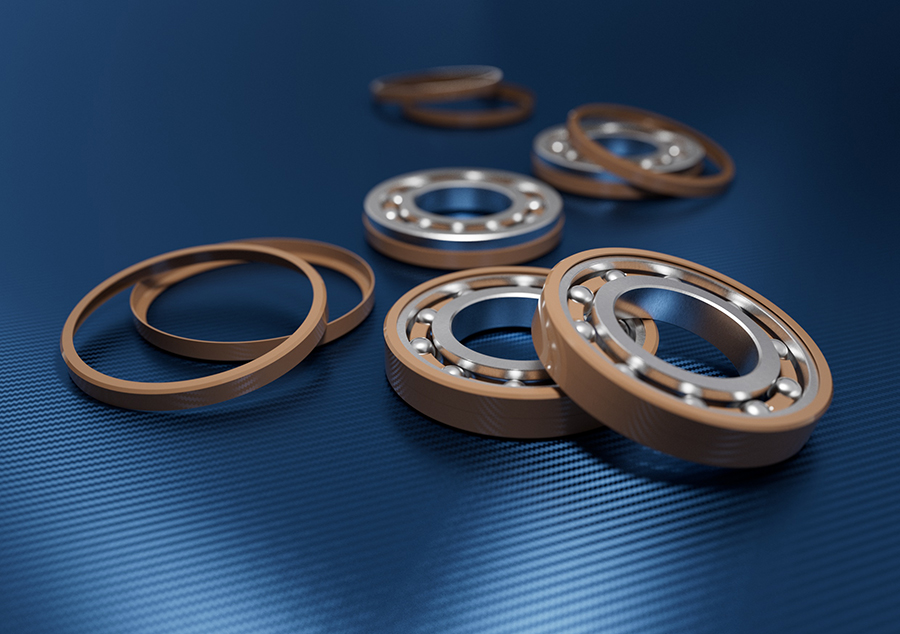
Duvelco Ducoya is available both as a moulding-grade polymer for use with suitable modern precision processing equipment and as finished components for integration by bearing manufacturers or OEMs.
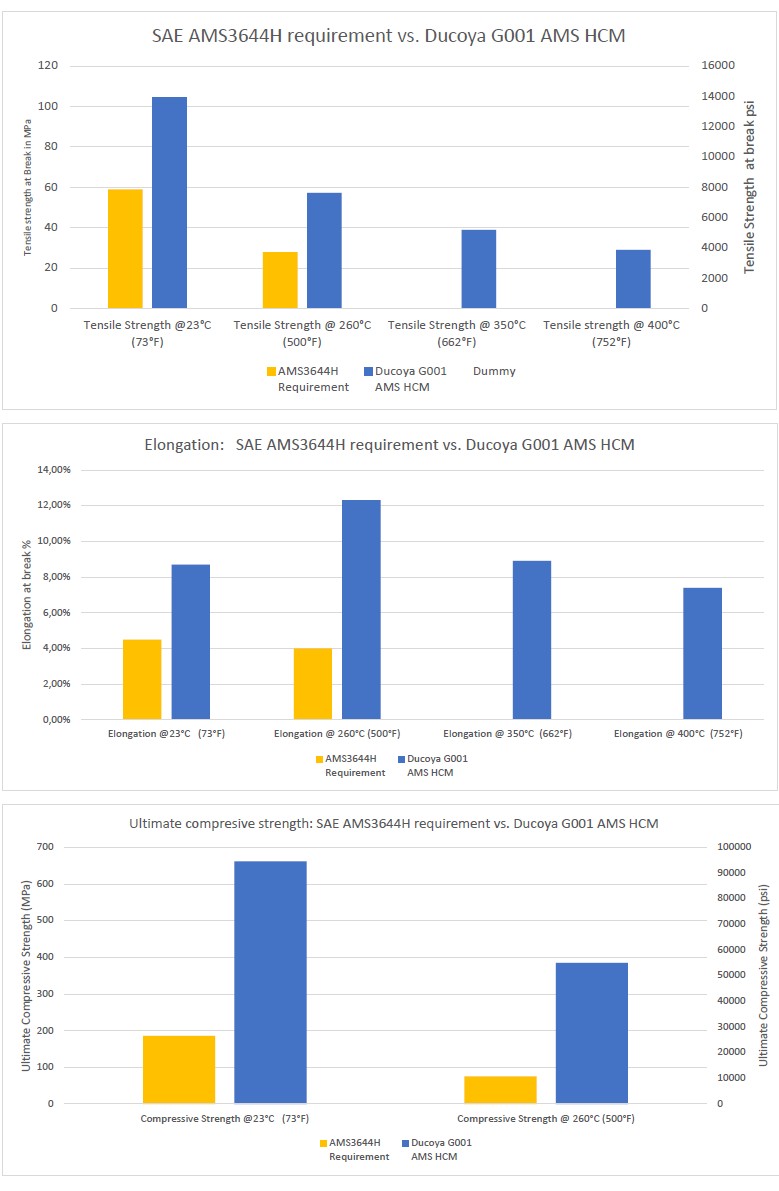
The preliminary data in the graphs below, demonstrates how Ducoya also exhibits high compressive and tensile strength and toughness at elevated temperatures, which may be advantageous across a wider range of applications.
As electrified powertrains continue to evolve, the focus is increasingly shifting from mitigating EDM risk to addressing it at source. Advancedmaterials such as Ducoya may offer new possibilities for more robust, spaceefficient insulation strategies, helping engineers explore alternatives to traditional approaches. The question is: could a material-led solution play a greater role in future drivetrain design?
[1] Silicon Carbide and Gallium Nitride.
[2] I=C. dV/dt
[3] Pauchard, P., Berger, C., and Jackowiak, R., “Effective Solutions for bearing Insulation to prevent electrical corrosion in E-Drive Systems” CTI Magazine, December 2025, pp. 25.