
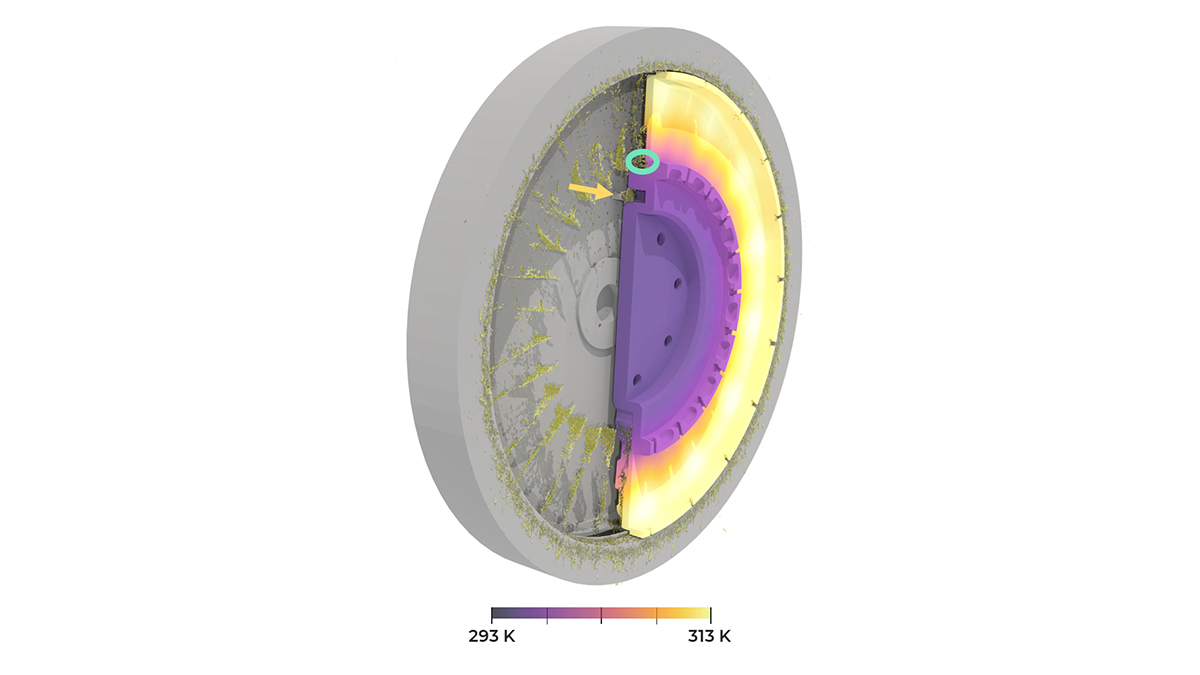
* Simulation results visualizing free surface flow of the oil jet (injection nozzle indicated by the yellow arrow) on the left side and heat distribution in the rotor on the right side, resulting from one single MPX simulation. The green circle marks the location of an infrared sensor.
Investigating e-motor thermals as a result of free-surface flow cooling strategies has long been a complex, laborious effort. We demonstrate a novel simulation method – Mesh-Particle Multiphysics (MPX) – which can provide high-fidelity insights from a single simulation run.
Johannes Becker, Dive CAE
Liam Pek, Dive CAE
Automotive drivetrain electrification presents major challenges to engineering teams, as performance, thermal, weight, and packaging requirements drive the need for increasingly efficient and power-dense designs. At the same time, global supply chain volatility drives the need for high-performance motors that do not rely on rare-earth magnets to enable domestic manufacturing and strengthen industrial resilience.
The primary objectives of drivetrain prototyping are to validate performance, efficiency, durability, and system integration before moving to production. Prototypes for e-motors undergo thorough load testing on test rigs and in demonstrator vehicles to confirm structural and thermal stability under expected real-world and extreme conditions. Insufficient cooling and lubrication leading to prototype failure results in costly iterative rework or even changes to the underlying system architecture, significantly impacting time-to-market.
While virtual testing of lubrication and cooling performance via simulation has been industry standard for years, it is often done in isolated domains, as workflows to combine particle-based simulations used for oil flow analysis and structural thermal simulations often involving multiple solvers and laborious processing steps that require deep numerical expertise. A novel solution to this problem, Mesh-Particle Multiphysics (MPX), enables single-run analyses of free-surface flow lubrication and cooling strategies including full conjugate heat transfer (CHT) through structural elements with timescale coupling. Leveraging the strengths of Smoothed-Particle Hydrodynamics (SPH) for the fluid dynamics of jet, spray, or sump cooling, and the Finite Element Method (FEM) for heat propagation through structures in one unified solver architecture reduces complexity and can reduce time-to-result in e-motor studies from weeks to hours.
The ORBIS ELECTRIC HaloDrive is an axial-flux electric motor architecture with a wide range of applications across industries, including as an in-wheel motor for passenger EV or commercial vehicle propulsion. Depending on the intended application, it supports different cooling strategies optimized for the expected load cycles, operational environment, and TCO.
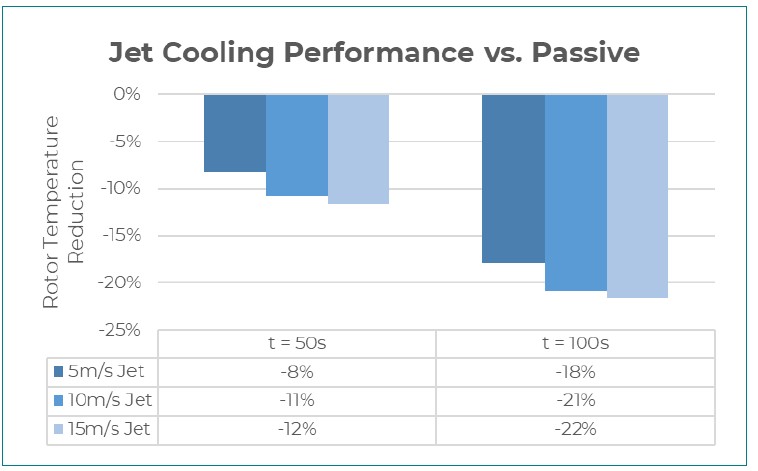
Using Dive’s MPX, we investigate thermal performance of rotor cooling, comparing a passively cooled rotor as a baseline case with multiple intensities of active jet cooling, axially applied to the rotor. Jet cooling is confirmed to reduce rotor temperature at the position of a radial infrared sensor (see green circle) by up to 22% after 100 seconds of runtime at 1,500 rpm. While the 5m/s jet configuration reaches steady-state temperatures after about 70 seconds of runtime, both 10 and 15m/s jet configurations stabilize around 30 seconds into the test, with diminishing returns of going beyond 10m/s.
Importantly, results for this study were obtained in a single afternoon – requiring less than one hour of simulation pre-processing and four to five hours (depending on flow rate) of simulation time. Executing thermal studies on complex free-surface flow phenomena enables simulation-driven design that produces advanced cooling strategies which are well-validated and understood before going into a physical prototype.
References
› HaloDrive model provided by ORBIS ELECTRIC. www.orbiselectric.com/halodrive
› Mesh-Particle Multiphysics (MPM). www.divecae.com/technology