
Théophile Allard, CTO and co-founder at Neural Concept
The automotive industry is undergoing a structural shift. Development cycles compress from years to months, regulatory requirements multiply and customer expectations rise. The automotive industry’s structural challenges feel more burning than ever: deliver better vehicles, faster, without sacrificing quality or cost.
For decades, the answer was adding more tools and specialists. But engineering organisations are fragmented, iteration loops are long, and system-level insights arrive too late. In perspective, AI looks like the perfect solution that will magically absorb workloads and shrink timelines. In reality, despite heavy investment, most initiatives stall at the pilot stage.
The issue is workflow fit, not AI capability. What is needed is a different engineering playbook, one built around how AI-native development actually works.
The fragmentation problem
Modern vehicle development involves hundreds of specialists across aerodynamics, thermal management, crashworthiness, NVH, and manufacturing, each operating with separate tools and timelines.
This workflow is deeply sequential: designers create geometry, analysts spend weeks on simulations, results return, changes are requested, the loop repeats. By the time conflicts surface, design freedom has evaporated. Today, AI can generate and evaluate thousands of design variants per day across multiple physics domains. The constraint is the old workflow, not ready to leverage these new technology capabilities.
From iteration to exploration
The shift happens when teams move from design iteration to design space exploration. Traditionally, engineers work on one design at a time, modifying CAD, running simulations, and interpreting results.
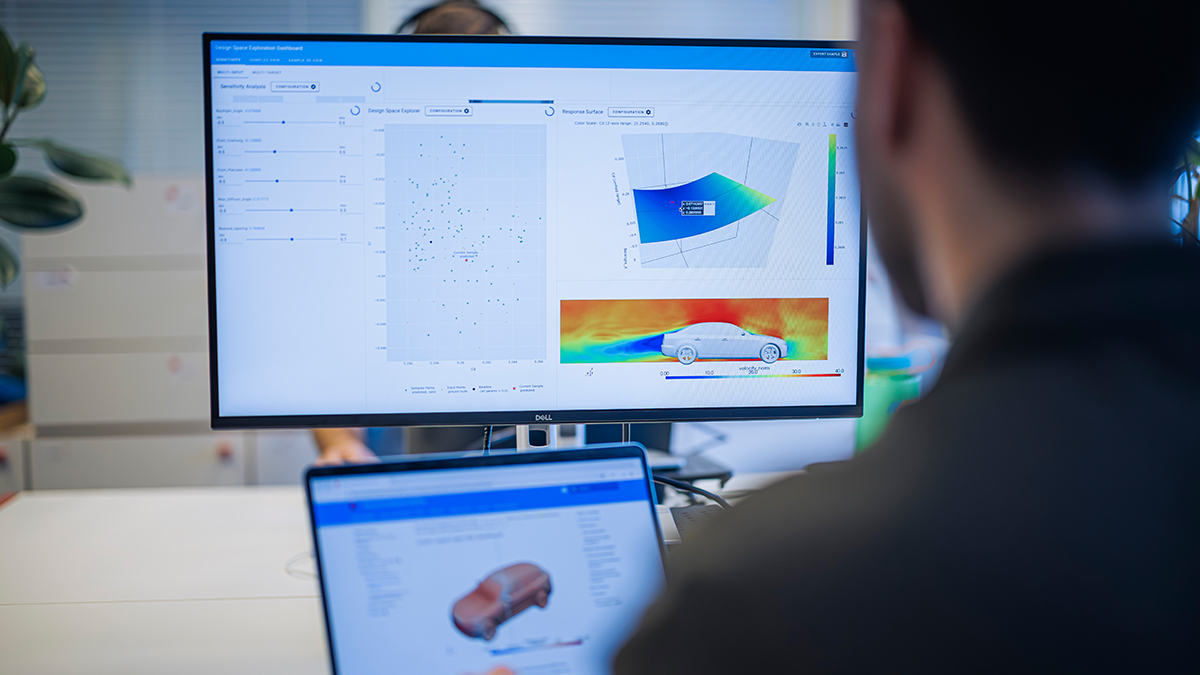
In AI-native workflows, engineers define a design space with rules, constraints, and performance targets. AI populates that space with thousands of variants. Engineers navigate possibilities, select promising designs, and refine constraints. This fundamentally changes how engineering knowledge is captured, shared and applied.
The intelligence layer
For this to scale, AI must embed in tools that engineers already use, not exist in isolated environments. In practice, AI functions as an intelligence layer connecting to CAD, CAE, and PLM systems through APIs. Engineers work in familiar interfaces but gain AI-powered features: automated geometry generation, real-time performance feedback and cross-discipline constraint propagation.
AI-based surrogate models trained on historical simulation data predict aerodynamic drag, thermal performance, or structural behavior with near-CFD/FEA accuracy at a fraction of computational cost. Engineers see design changes consequences in real time, early exploration happens where iteration is cheap and fast, and promising candidates get validated with high-fidelity tools only when needed.
At scale, this approach collapses development timelines, reduces late-stage redesigns, and shifts critical decisions to phases where design freedom remains high.
The path forward
For organizations ready to make this shift, the first step is identifying workflows where fragmentation causes the most friction and faster exploration would deliver clear value. Aerodynamics and thermal management are common entry points: physics are well understood, simulation data is abundant, and geometry changes have measurable impact.
But success requires more than deploying technology. Engineers need training, infrastructure must support AI workloads at scale, and organizations must accept that this transition will not happen overnight. Those who get it right will make designers more productive, decisions more informed, and better products.