Edoardo Freschi, EV-Traction Sales Director, IMA EV-TECH
It was early in 2009 when ATOP started developing the first fully automatic line to produce hair-pin stators. Being a medium-sized company and not having, at that time, the capacity to support such a wide range of solutions, it was necessary to make a choice between the well-known, state-of-the-art coil insertion technology or exploring the brand-new copper bar technology with a pioneering approach. With a focus on the future, the choice was to explore this new territory and today we can say the decision was the right one.
As has always been the case in over 30 years of IMA EV-TECH – ATOP history, process equipment must preserve some of the unique characteristics that have always distinguished our machines: they must be innovative, flexible and compact in design.
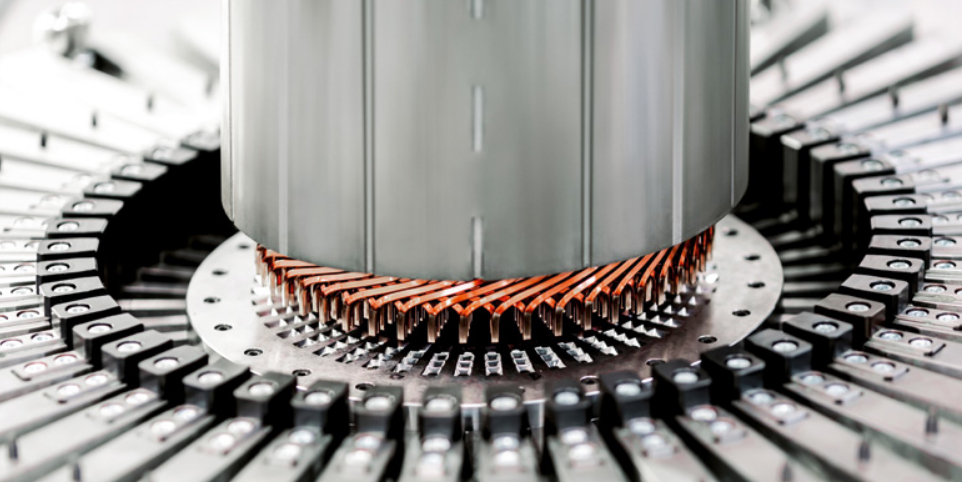
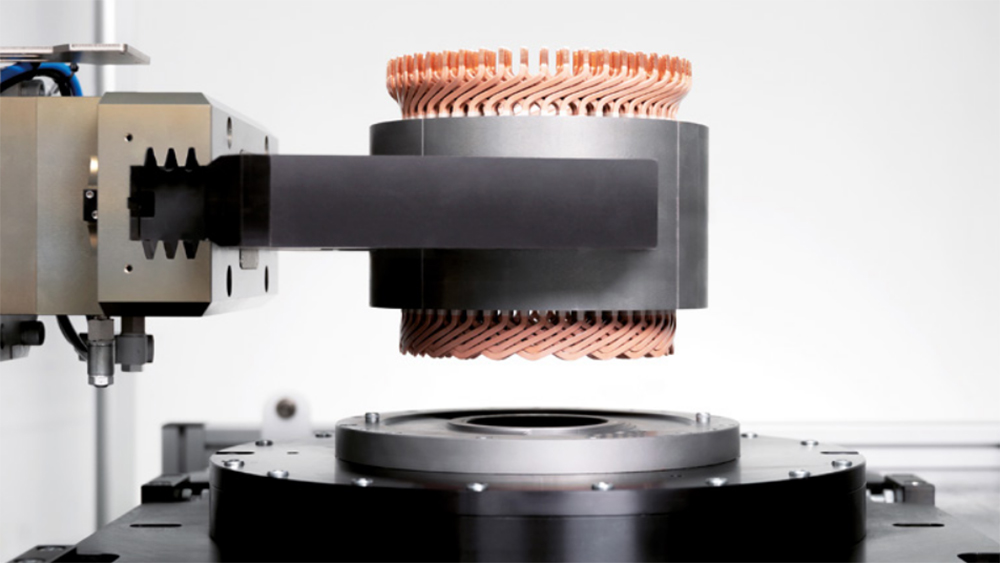
The main focus was on hair-pin forming process, considered the true key to the success of this new solution. The innovation requirement was met through the introduction of a CO₂ laser for enamel removal on the wire combined with a fully programmable 3D forming robot used to bend copper wire. This solution perfectly matched the second prerequisite of flexibility. In fact, like for the pin forming, all machines in the line had to be suitable for different products with varying dimensions, slot geometries, and conductors per slot.
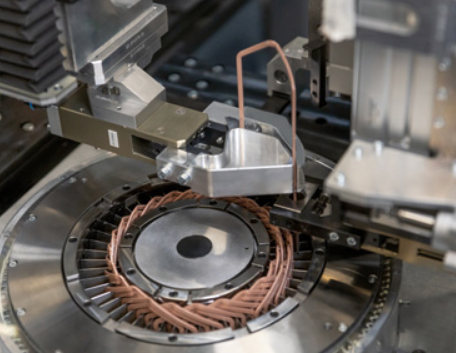 The application of QCO (Quick Change Over) technology to the new machines in stage of development, appears as a perfect combination. New machines are born with the natural predisposition to receive different sets of tooling for different products. The idea was to have a complete tool installed in the machine with fixed references,requiring no fine-tuning or adjustments to start production. Given the high value of EV motor components, it was defined that, after all quality checks, the first part produced must be a good part. The presence of electric axes to control all process functions definitively helped engineers in their work.
With the experience gained in the electric motor manufacturing field, it was considered an added value to approach the third pre-requisite: compact design. We integrated the electrical and pneumatic cabinets inside the machine frame. Further on, we had chance to learn how automotive industry standards were different in this field. While Tier and Tier 2 customers accepted this solution, OEMs required a more conventional external electrical cabinet. To satisfy both philosophies, today both configurations are available.
In over 15 years of experience with copper bar stators for e-Mobility applications, we have grown our experience thanks to the scientific approach always applied even through a close cooperation of our R&D with universities. Nonetheless, events and reaction of the copper that initially appeared to be inexplicable, have gradually found their explanation. Experience taught us to define the copper “the alive material” because, like a chameleon is capable to change his characteristics so quickly and sometime without any apparent reasons.
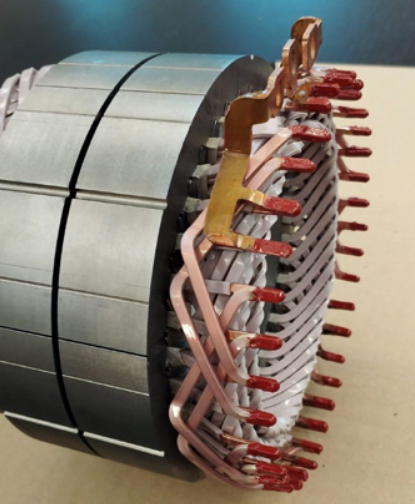 Welding is keen while producing the hair-pin technology. From the very beginning the idea to use a mask to align the couple of wires was developed and applied. This solution was later abandoned in all those cases of high slot numbers and small diameters. Where it was preferred clamping by gripper. Today, the alignment by mask is made using a three-effect mask that allows to make tangential and radial wires alignment while providing axial containment. The new mask, thanks to its reduced thickness, perfectly meets the needs of extremely short wire leads, those known in Asia as “minipins”. This is not a novelty, since we already have high-capacity lines in serial production with wire terminals below 6 mm in straight path.
The current state of the art is the ATOP machines generation that represent the fourth generation of machines developed for hairpin stator technology. Maintaining the original pre-requisites, achievements of this latest generation, are the condensation of all experiences matured in those year, with higher process speed and productivity.
What about the future of e-mobility motor design? It is a widely shared opinion that hair-pin stators may represent a transitional solution toward a simpler and more cost-effective process.
Here at IMA EV-TECH, we continue to monitor developments and, just as we did 15 years ago, try to explore possible alternatives. Wave winding, as it stands today, presents clear limitations in terms of motor design constraints, lack of process control, cost, floor space occupation of the production lines and difficulties in achieving a fully automated process.
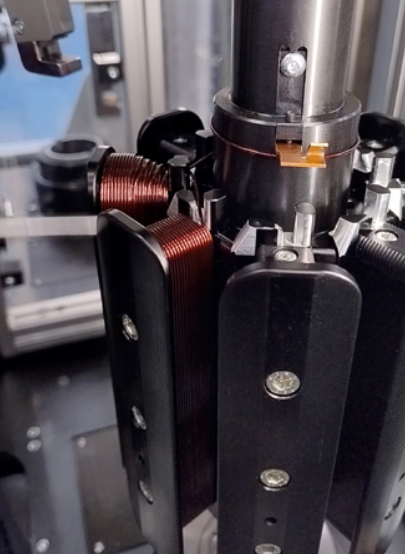 An interesting alternative to traditional wave winding is the CFW solution, acronym for Continuous Flow Winding. This technology was developed to meet the requirement of the motor from MAVEL. This already solved most of the criticality typical of a wave winding:
- Closed-gap inner diameter, because the insertion is made from outside
- Helicoidal slot profile, offering a well-distributed magnetic flow distribution and helps tremendously on having in a smooth wire insertion process
- Small waves development, that leads to compact footprint equipment. A complete line having the floor space occupation similar to an hair-pin stator line
- Low-height copper headers outside the slots, with crown height contained below 24 mm thanks to outer-slot insertion
Applications with Litz-wire have been developed in recent years, with flexible conductor used to wind single poles stators as well as rigid bars for hair-pin production. It is hard to define what the future will bring, but one thing is sure: IMA EV-TECH will be there supporting the growth of our customers.