
Kim App, VP Sales & Marketing, Marel Power
Electrification is redefining passenger vehicles and heavy-duty trucks, placing new demands on efficiency, power density, scalability, and supply resilience. At the center of this shift is the power conversion layer — the link between the power semiconductors and the systems that deliver motion. Marel’s architecture rethinks how electrical and thermal paths work together, allowing semiconductors to do more with less. The result is a platform that cuts size and weight by 50% and semiconductor count by a third, while staying flexible across applications and semiconductor suppliers. To be clear, Marel does not manufacture semiconductor die, nor does Marel build full inverter systems. Instead, Marel delivers ultracompact power stacks that sit between the two, enabling performance levels that conventional architectures cannot achieve.
Unlocking More from Every Die
Traditional power modules limit performance through high thermal resistance and parasitic inductance. Conventional designs place dielectric material close to the die, restricting heat removal, while inefficient electrical paths introduce overshoot, ringing, and switching losses. Our architecture addresses both by relocating the dielectric closer to the coolant, and double-sided cooling of the die and enabling a more direct thermal path., increasing thermal capacitance and thermal conductivity. The result is ~0.05 K/W thermal resistance junction to coolant (8 SiC per switch), and ~2 nH parasitic inductance. This enables each semiconductor die to operate closer to its true capability, increasing current per die and reducing the number of die required to achieve a given power level—lowering system cost.
Compact Scalable Power for Mobility
The architecture is inherently modular, easily scaling from hundreds of kilowatts to megawatt-class systems. For passenger vehicles, this enables smaller, lighter inverter systems. For heavy-duty trucks, it delivers high continuous power in a compact form while reducing cooling system size and complexity. Requiring fewer semiconductors and supporting both IGBT and SiC from multiple suppliers, the system also improves supply resilience and adaptability to support evolving technology roadmaps.
A New Foundation for Electrification
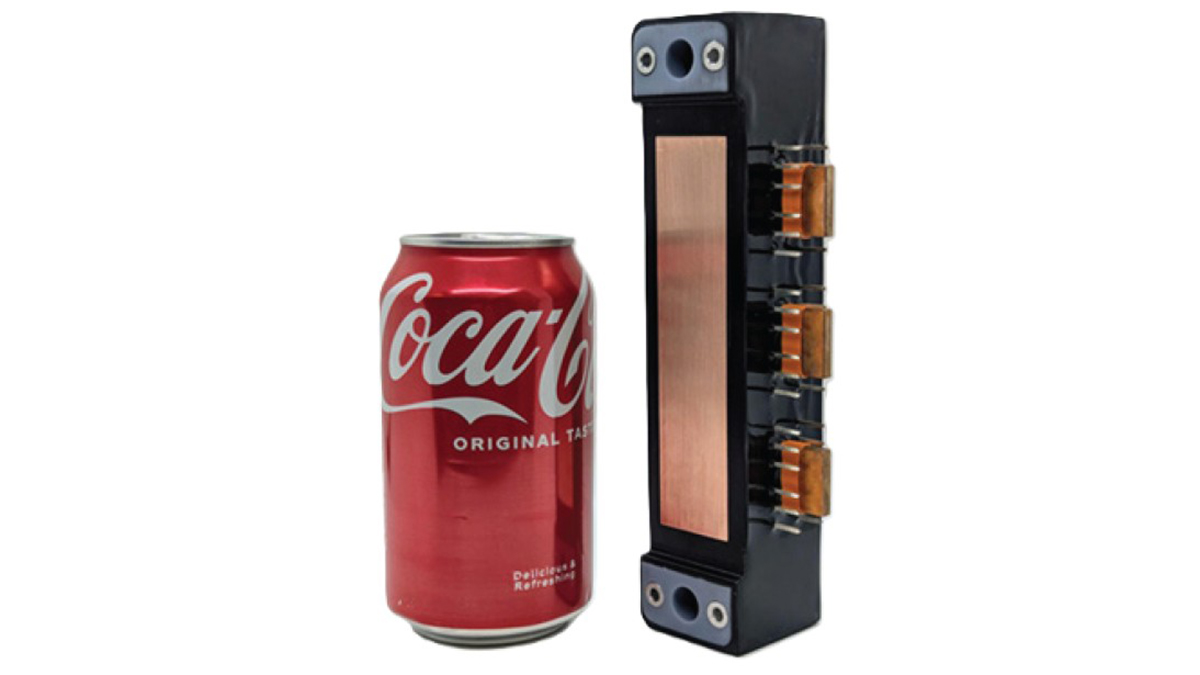
Marel operates between semiconductor suppliers and system integrators, providing the core power stack that enables next-generation inverters and converters. A simple visual—such as a 1 MW power stack next to a Coke can—makes the value clear: exceptional power density. By rethinking how power is packaged, cooled, and scaled, this approach delivers meaningful system-level advantages in size, weight, performance, and flexibility. The result is not just incremental improvement, but a structural shift in power conversion designed for the next generation of mobility.