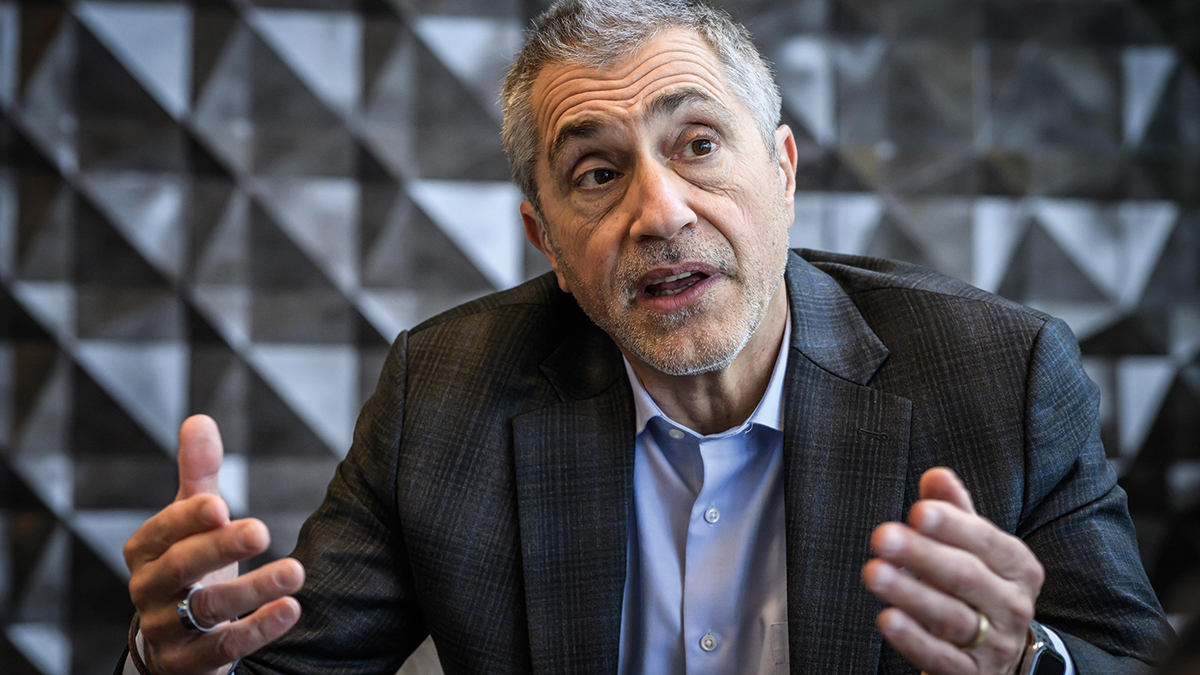
Adrian Tylim, Head of Business Development, Blue Solutions
Blue Solutions makes solid-state batteries in France and Canada. Series production is scheduled to begin in 2029, with significant advantages in energy density, cost, and safety, says Adrian Tylim, Head of Business Development. On the CTI Symposium Novi in May 2025, we discussed the prospects for solid-state batteries, and the company’s polymer-based technical approach.
Mr. Tylim, what are the functional challenges when developing solid-state vehicle batteries?
There are several. It’s a very competitive industry that attracts money, specifically for advanced and solidstate batteries. Many companies say they have solid-state batteries, but some may just produce small samples in a lab. When you start putting them into an application, it’s tough to increase the size of the cell and maintain or improve the performance. In the lab, the cell is usually the size of a coin, and increasing the size, voltage, etc., is a challenge. The second challenge is that you want to produce quickly, and on a large scale. For that, you need to develop a perfect process, which requires a lot of innovation. Then you have requirements in terms of safety and performance, and issues with decoupling from risky material supply chains. And of course, you want to produce the best product. Not many companies can meet those requirements in line with customer expectations.
In terms of production, what advantages do you have compared to ‘conventional’ Li-Ion batteries?
Lithium-ion batteries are easy to produce and have become very cost-competitive on a large scale. They are made all over the world, they have been manufactured and deployed for decades, and the technology is still improving. So anything we design to replace Lithium-ion must have specific advantages. One main focus is safety. Lithium-ion batteries have a liquid electrolyte. When a cell is defective, you get thermal runaway: the cell ignites, and the fire propagates from cell to cell. Our solid-state batteries have a solid electrolyte that doesn’t catch fire as with lithium-ion cells. We chose an electrolyte that surpasses the melting point of the lithium anode, which is the key variable in terms of thermal stability. The second main focus is manufacturing at cost and integrating the technology into the vehicle. Other solid-state advantages are longevity, more charging cycles, and higher energy density.
What kind of electrolyte material do you use?
Our material is a solid-state polymer. In the battery world, we talk about solid-state materials and semisolid-state materials, which contain a little liquid. For strictly solid-state, you have either ceramics or polymers. And within ceramics, you have oxides and sulfides. We chose a polymer material for several reasons. One is that Blue Solutions has a legacy of making films and ultra-thin films. We have developed a very simple process with a small manufacturing footprint. We make everything from raw materials. We extrude the lithium metal anode, the polymer electrolyte, and cathode. In the case of the anode, we start with a lithium metal cylinder. We extrude it at high speed, make it very thin, wide, and consistent, and then roll it. We do similarly with the polymer electrolyte. For the cathode, we have different dry coating or extrusion processes. And then we slit them and stack them to form our cell.
Speaking of so-called semi-solid-state technology, how do you rate its prospects?
Automotive batteries often have 100 layers, or 50 double layers. Whenever you charge and discharge the batteries, the stack basically expands and contracts. It’s a process we call ‘breathing’. So let’s say a vehicle is going to be out there for ten years. To ensure longevity, you must ensure all the interfacial contact between those layers stays intact. With ceramic materials, you need a lot of pressure to maintain that contact – between 5 to 20 bar. For that, you need a lot of mechanical components such as springs. But the more mechanical components you use, the less space volume is available to put energy storage inside the car, and the more complex and expensive it becomes. So we opted for a polymer material, which is elastic, so the interfacial contact remains intact with very little pressure and minimal components needed. Semi-solid attempts to do the same thing as we’re doing with our polymer, only using a ceramic material with a porous structure that contains some liquid. So while polymer may not be the best ionic conductor, when we look at all other beneficial aspects, we believe polymer is the sweet spot.
What are the USPs of your Gen 4 technology and Blue Solution’s capacities?
So far, we’ve made more than three million cells. Most of them fitted to commercial vehicles starting in 2011. Since then, there have been many improvements and lessons learned, which we have integrated in line with the requirements of our automotive customers. For example, the ability for the electrolyte to work at room temperature, even as the battery functions in temperatures from -20 to 60 °C. Additionally, our cells have been performing over 3,000 cycles, far exceeding the typical OEM benchmark of 1,000. This allows us to use an even thinner anode. The thickness is now <20 μm, compared to 60 μm in the third generation. Also, we can now service different vehicle market segments by using different cathode materials, like NMC or LMFP, and varying energy densities of up to 450 Wh/kg. After all, a Ferrari and a Fiat have different requirements. And by varying the cathode materials, we can scale the costs and performance of our cells. We are currently working with three automakers: BMW, and two others in the Top Five. We’re also cooperating with a Taiwanese electronics company, and we’re looking at twowheelers and other areas. Right now, we are at a point where we’re tweaking the chemistry and the form factor, for example, prismatic or pouch cells, etc. We are in the validation phase and expect to start series production around 2029.
How is the supply situation for the raw materials in your cells?
Sustainability is a core development goal for us. At the end of life, we can reuse all critical materials to produce new cells. We have also filed a new patent to extract lithium metal from the cells. The good thing is that we never use materials like copper. For our cathode current collector, for example, we only use aluminium. And for the anode, the collector is the lithium-metal foil itself. Also, polymer materials are not rare, so we have several suppliers – not just China. I don’t see any problems with the supply chain. And we have 20 years of experience in locating and sourcing materials for iron phosphate, lithium, and so forth.
How do energy density and costs compare to current state-of-the-art batteries?
That’s one of the most critical questions for customers! I could give you today’s figures, but it wouldn’t help much because our goals for series production in 2029 are 20 to 40 % higher density than the best lithium-ion battery, at unit costs of 20 to 40 % less. That’s the target we think we can achieve. When visitors tour our manufacturing plant, they are amazed at how simple our manufacturing is, with such a small footprint. For example, there’s no need for the calendering process used by lithium-ion battery manufacturers . And there is no need for an electrolyte filling process. So we save money on equipment, around 20 or 30 % of the CAPEX which should impact the price of the final product. And finally, another benefit is that there are fewer environmental requirements due to our simpler, which again lowers the costs.
When will we see your technology on the streets, and what market penetration do you expect?
As I said earlier, our goal is to start production in 2029. It’s hard to predict, but we think solid-state batteries can reach a market penetration of 5 % in 2030 and about 8 % in 2035. Based on what we see, and on analyses from some of the best sources, that seems realistic.
Interview: Gernot Goppelt