Geoff Lewis, Technical Director, Duvelco
What is a New Material?
Being ‘new’ is claimed with some regularity in the world of polymers; however, step changes in performance are less frequent. Here, I am going to look at an innovation that may pass the test and rightfully be called a new material. The polymer in question has the trade name Ducoya.
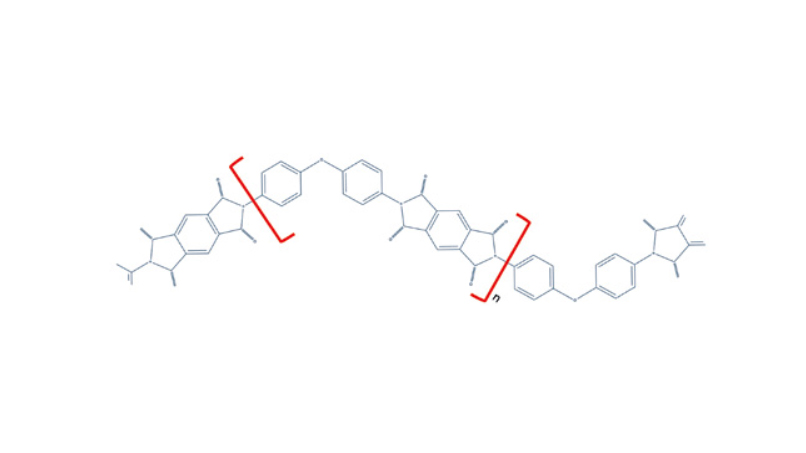
In terms of chemical type, it is a semicrystalline thermoplastic block copolymer bearing the unfamiliar name PMDA-ODA or, in long form, PyroMellitic DiAnhydride – 4,4‘-OxyDiAniline. The repeat unit is shown below:
This is a polyimide with an ‘I’; not a polyamide. Polyimides are a vast and rapidly growing class of polymers. The number of polyimide papers written annually has exploded in recent years. Polyimides include thermosets, thermoplastics, amorphous, semicrystalline, and photo-imageable materials.
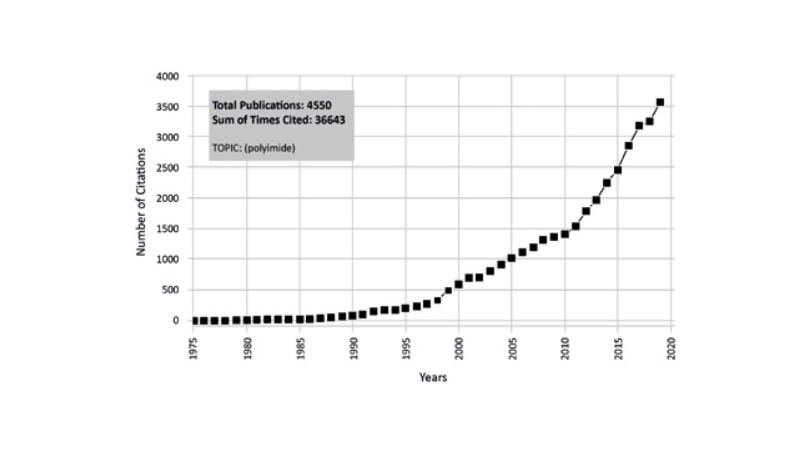
The above graph shows the number of papers regarding polyimide. Source: Researchgate – Number of citations per year from 1975 to 2019, Web of Science.
Some may recognise this molecule as being from the 1960s; however, that is not the new part. This molecule, initially developed for NASA’s space programme, has long seemed too difficult to source and too expensive for many automotive applications.
This is especially the case as the industry moves into an era of cost-competitive BEVs, and, from a European and North American perspective, an era of low-cost, possibly subsidised Chinese BEV imports to compete with.
So, if it isn’t the molecule, what is new?
The innovation here is a new, patented manufacturing process that also covers the resulting material. Many high-performance plastics, including those produced by the traditional PMDA-ODA Manufacturing method, utilise monomers dissolved in harmful, high-VOC solvents. The environmental and high-cost considerations of these solvents mean they must be separated, distilled, and reused, consuming a large amount of energy in the process.
Ducoya avoids most volatile solvents used in the process and instead employs supercritical carbon dioxide and a catalyst.
Therefore, it is straightforward to separate the polymer from supercritical carbon dioxide by lowering the pressure. The carbon dioxide is repressurised and stored for reuse. This single step greatly streamlines manufacturing at scale, making the polymer considerably more accessible for automotive applications. However, this is not the end of the story. While the original aim of the invention was to simplify manufacturing at scale, when the properties of the resulting polymer were compared with those of its traditional predecessors, something remarkable emerged – dramatically improved mechanical and tribological properties.
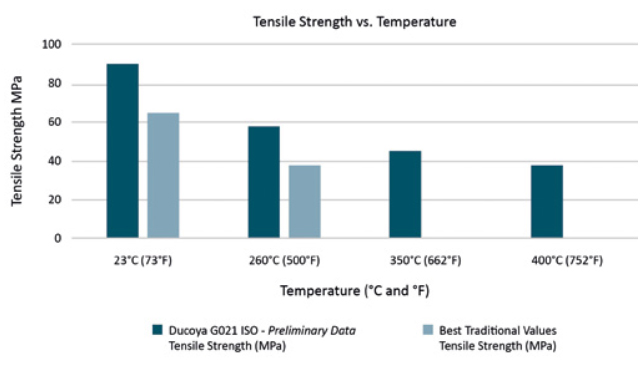
The above graph consists of Ducoya preliminary data – arithmetic mean of five specimens, and best traditional values taken from published datasheets, none of which reported data over 260 °C.
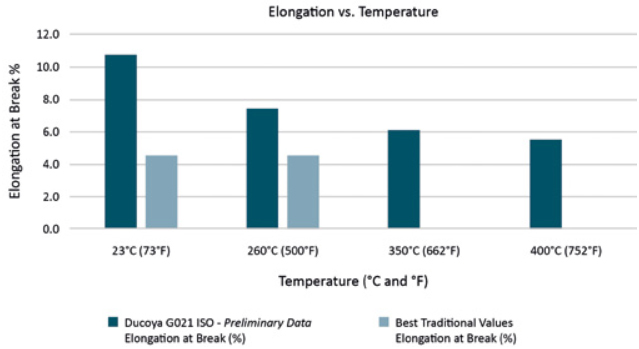
The above graph consists of Ducoya preliminary data – arithmetic mean of thirty specimens, and best traditional values taken from published datasheets, none of which reported data over 260 °C.
Datasheet1
Ducoya G021 ISO is a filled version of Ducoya, containing 15 % wear- and friction-optimised graphite. Initial investigations of tribological properties in dry conditions indicate a significant improvement in wear factor compared to the best traditionally produced polyimides of this type. While much work remains to be done with this
specific molecule, this result seems to confirm earlier work by Irisawa et al. on several polymers, showing that the wear rate is inversely proportional to the product of tensile strength and elongation.
Of particular importance is the continued performance of this molecule at significantly elevated temperatures. This is because, when dry friction occurs – whether by design or due to off-design operation under adverse conditions – temperatures on the wear surface can rise substantially compared to the bulk material. For instance, regular operation at 120 °C can quickly lead to temperatures exceeding 240 °C on the wear surface under harsh sliding conditions (High PV value).
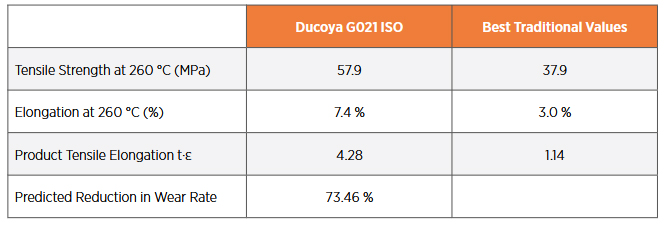
It should be noted that this general hypothesis applies only to materials of the same type (in this case, PMDA-ODA polyimides) and only when tested under identical conditions. Further work will determine whether this prediction holds for Ducoya G021 in comparison with other PMDA-ODA polyimide polymers.
Why would this be important to Battery Electric Vehicles?
As BEVs increase in torque, while package space and cost must decrease, this can lead to higher PV values as the available load area diminishes. This also reduces the weight of single-speed and multi-ratio transmissions. Epicyclic transmission layouts may particularly benefit from this improvement. Furthermore, Ducoya, being wear-resistant, although still relatively soft compared to metal, allows metallic debris, such as burrs and wear particles from gears, to embed in its material and be removed as contaminants from the lubricating oil. While this embedding must be limited, removing metallics before they can interfere with the proper functioning of the electric motor – often sharing the same lubricating oil as the transmission – can only be beneficial.
Conclusion
An interesting new material that adds a new dimension to accessibility and performance in automotive applications. Here, we have focused on mechanical and tribological properties.
Future Work
Future publications will describe why this unusual and newly applied process using supercritical carbon dioxide should lead to such improved mechanical and tribological performance.
Opportunities arising from the resulting electrical performance in conjunction with the latest high-precision
moulding techniques will be highlighted.
In addition, test results will be published in which the relationship between t·ε2 and wear rates in various
situations, as described above, will have been investigated.
1 DuPont Vespel® SP-21 ISO Reference No. VPE-A10863-00-B0614 published 2010 and 2021.