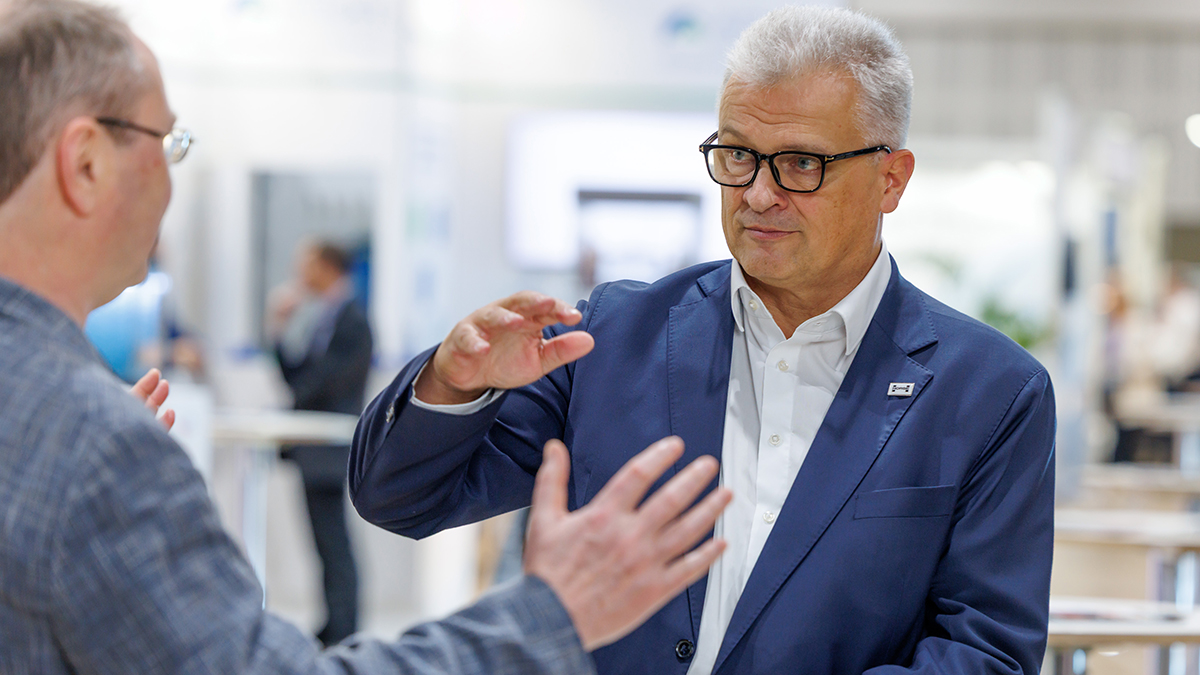
In addition to dedicated hybrid transmissions, Horse Powertrain also supplies dedicated combustion engines and complete drive modules. At the 28th CTI Symposium in Berlin last December, we spoke to Ingo Scholten, CTO of Horse Powertrain, about developments in current and future hybrid technology.
Mr. Scholten, Horse Powertrain has a broad portfolio of hybrid drives, but also produces its own dedicated hybrid engines and ICEs. That’s unusual for a Tier 1 supplier …
It is. There used to be a lot of ‘transmission-only’ suppliers for manual transmissions, automatics etcetera. But usually, OEMs made their engines and dedicated hybrid transmissions, or DHTs, in-house. Now we offer both – as a system supplier. That makes us quite special to our partners. Instead of just components, we can also offer entire drive systems – plus full integration support, including topics like emissions and homologation.
What are customers asking for?
Firstly and naturally, we still make drives for Geely and Renault, our parent companies. The Renault E-Tech hybrid, for instance, is now in its third generation. For Mercedes, we supply a 1.5-liter combustion engine for mild hybrids. In China, we’re developing our dual-motor DHTs, which now use dual-shaft transmissions instead of planetary gearing in earlier years. And we’re talking to other customers in Europe and the US. The demand there for full hybrids is even stronger than in China, but they also want PHEVs. We are discussing range extenders more and more, too. In China, it’s mostly long-range PHEVs with a parallel option; they have big traction motors, and drive like EVs. In Europe, drivers still use manual transmissions so multi speed system are accepted even in combination with electrification. But in China, multi-speed transmissions can be a problem because customers there expect an EV driving experience.
Dual-motor hybrid drives are gaining ground. When do you use serial-only, and when is serial-parallel better?
For maximum efficiency, including on highways and rural roads, you’d normally use serial-parallel – mostly P1 and P3. A serial-only drive would cost you 4-5% in efficiency. Parallel or multi-speed transmissions are better for higher tractive force requirements. P2 still has its place for small vehicles in segments A or B. And if you already have an all-wheel-drive system with an electric rear axle, P2 is fine there too; you don’t really need a hybrid drive with two electric motors in the front then. P2 can also work when OEMs design vehicles as ‘BEV native’ or ‘BEV first’, respectively. Space is limited, so a P2 with a single electric motor can be practical when a market needs a hybrid variant of the BEV.
Looking at P1/P3 hybrids, we’re seeing solutions with a single fixed gear, and solutions with two, three, or four gears. What do you think will prevail?
When markets want cars that ‘drive like a BEV’, it makes sense to have fewer gears. Often, just one is enough. For high towing capacity, you can use multiple gears to modulate tractive force. When customers ask us for advice, we often recommend either a large traction motor with one fixed gear or a powertrain with four gears and a smaller traction motor. As I mentioned, Renault has a successful solution that’s now in its third generation.
Many OEMs still need two vehicle platforms; others are moving to ‘BEV first’ and using a BEV platform for hybrids, too. What’s your approach?
That’s currently one of our main topics, as I showed in my presentation here at CTI. Some vehicles still use traditional hybrid architectures, which require certain compromises; others use BEV-only architectures. A hybrid drive with one or two electric motors requires more space than an ICE-only drive, whereas a BEV drive requires much less. So, if you optimize a vehicle’s front end for BEV, the installation space is shorter and, above all, narrower. The subframe mountings are configured differently, the drive shafts sometimes go in front of the axle. And then a traditional hybrid drive won’t fit. You need a hybrid drive design that fits within a BEV vehicle architecture without requiring OEMs to compromise their BEV optimization.
Which of your products meet that requirement?
Firstly, there’s our highly compact HORSE G10 for range extenders. It has a two-cylinder boxer engine with a compact pushrod design and a generator mounted directly on the crankshaft. Then we developed the HORSE C15, a range extender as well. This can be installed either vertically or horizontally. And then we have the Future Hybrid System, which is available in P2 or P1/P3. According to our research, it fits most of the dedicated BEV platforms currently available. So, if European customers with a BEV-first approach want a hybrid derivative for their platform, they can use these powertrains while still meeting all the BEV crash-test requirements.
You also offer dedicated hybrid combustion engines. What are their thermal efficiencies, and how much more is possible?
We are in production with over 44 percent break thermal efficiency. And those are figures from engineering, not marketing. We’re aiming for 49-50 percent. But to get there, we need to implement a few more technologies – for instance, lean combustion. We also then need to design exhaust systems that won’t significantly increase overall system costs. On the other hand, ICE dynamics are lower in serial operation, so that simplifies exhaust after-treatment to a certain extent. For tomorrow’s lean-burn engines, the key is to keep lambda above 2.2 as much as possible so after-treatment doesn’t get too complex.
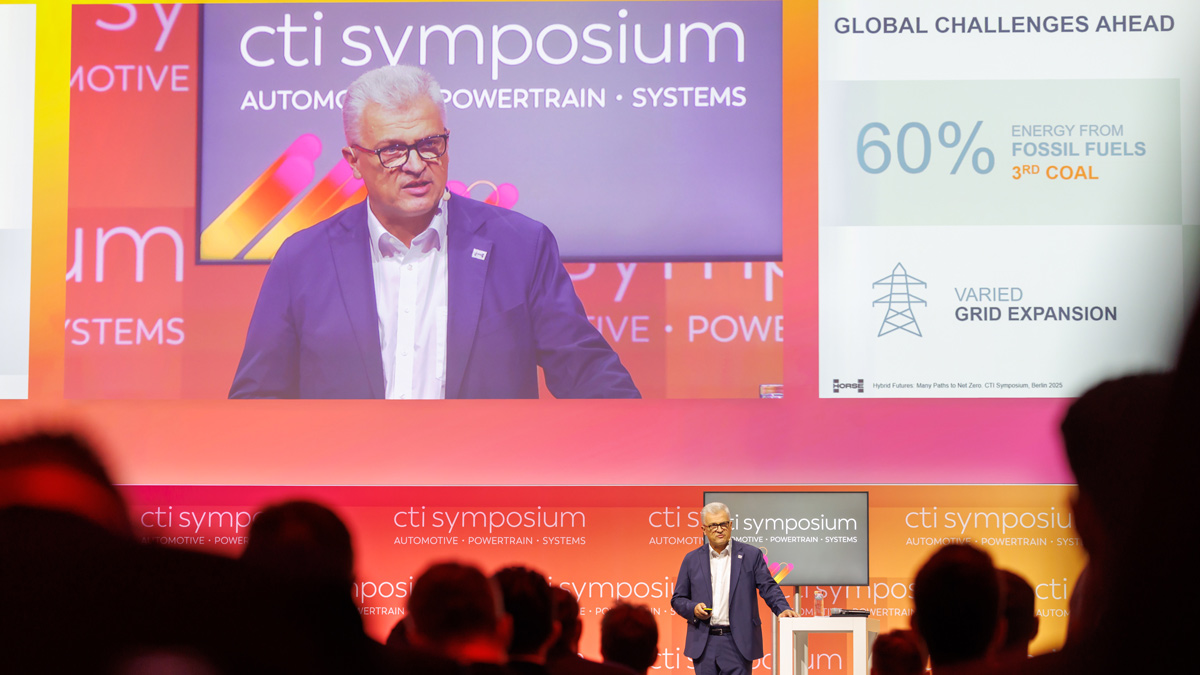
Ingo Scholten during his presentation at the CTI Symposium 2025 in Berlin
How do you rate the potential of synthetic fuels in terms of lower CO2 emissions?
Nobody expects all the markets to switch to synthetic fuels in the short term. But it could well be a gradual process. In five years’ time, maybe we could add five percent of synthetic fuels, then later fifteen percent, or twenty. The really good thing is that you can reduce CO₂ across your whole existing fleet. Methanol is another field in which Geely is working. They started selling methanol engines in 2013. Originally, these were 100 percent methanol, designed for taxi fleets in regions where methanol was basically a by-product of coal mining. But now they’re working with bio-methanol and trying to create a circular economy there. At last year’s Vienna Motor Symposium, Geely presented onboard CO₂ capture for trucks, for example. Some innovations are just getting started, but we’re already seeing potential here and there.
The EU Commission has just reopened the window slightly for combustion engines after 2035. What do political decisions like this mean for Horse Powertrain?
None of our products is specifically designed for Europe. Our product strategy is very broad, with products we use in the European market, Brazil, India, and elsewhere. So, in terms of capacities and defining technical requirements, decisions about the time after 2035 don’t affect us that much. As a globally operating company, we offer solutions that can meet the requirements of various and changing markets.
Interview: Gernot Goppelt.