
Dr-Ing. Philippe Farah, CEO – Founder YEESMA SARL
Dr-Ing. Shafigh Nategh, CTO – Founder, YEESMA SARL
Yu-Chi Tsai, Business Development & Marketing, YEESMA SARL
Electrically Excited Synchronous Machines (EESM) is one of the strong candidates to solve the supply chain risks, costs and sustainability issues due to the Rare-Earth magnets presently used in almost 90 % of the Traction Motors. However, for long, EESM presented lower Performances, especially in terms of Torque density: approximately 10 to 20 % bigger volume required combined with Lower Efficiency (down to 3 %) compared to Radial Flux Interior Permanent Magnets Solutions considered as today’s Benchmark.
Introduction and Objectives:
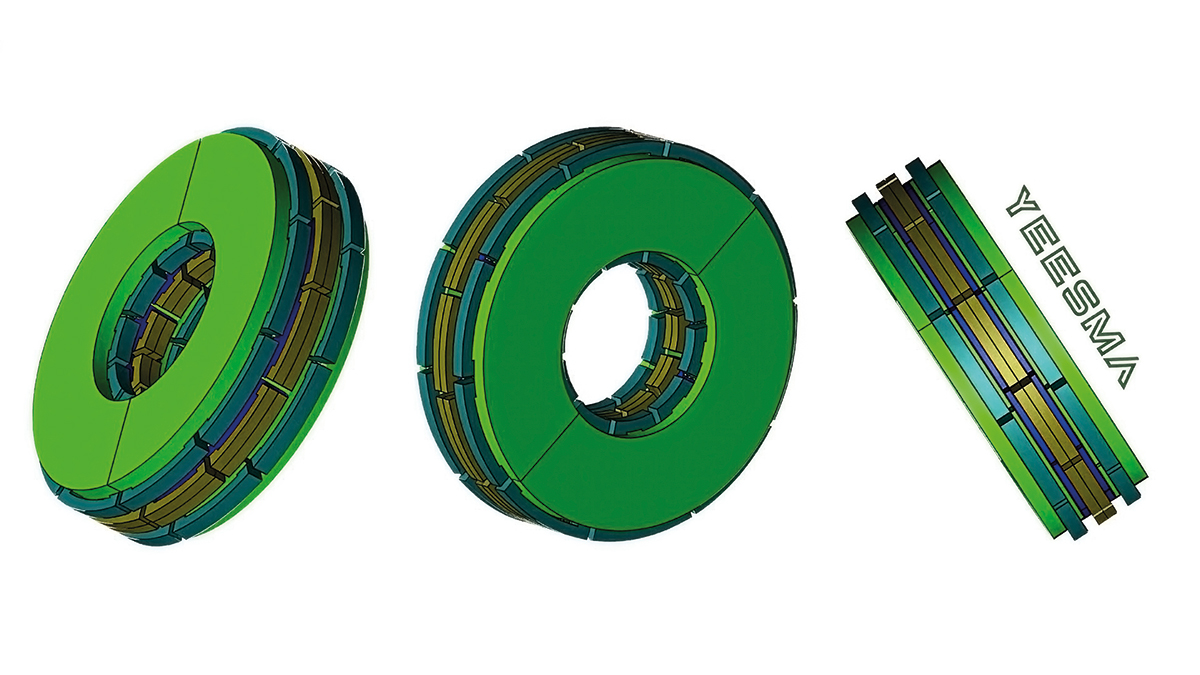
YEESMA combined 2 major concepts into what’s called YEESMA that stands for Yokeless (Yoked) Electrically Excited Synchronous Machines. This Proprietary solution consists of an Axial Flux AND Electrically Excited Topology. Preferred topology is a Dual Rotor, Single Stator that helps solving the Packaging and Performances challenges: up to 20 % Torque volumetric density, with more than 60 % Bill Of Material (BOM) cost reduction AND 60 % Higher Sustainability Index.
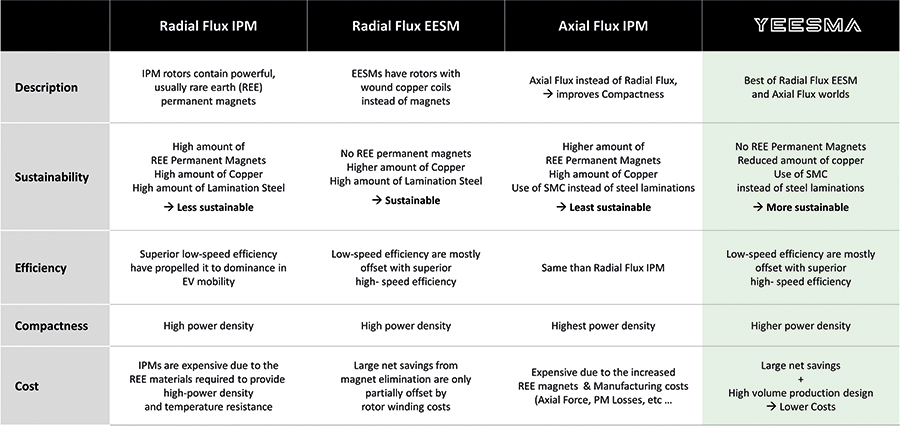
Figure 1: Topologies Comparison
Inverter Phase current is also significantly reduced thank to a Unity Power Factor and participates to the 60 % Cost reduction mentioned above.
YEESMA Technology
YEESMA solution is an Axial Flux based topology. Preferred solution is typical Single Wound-Stator sandwiched between 2 Wound-Field Rotors. Note that intrinsic to Axial Flux, inner diameter areas being “empty”, YEESMA can incorporate there both Position Sensor and Rotor Power Supply (being Brush type, or Brushless Inductive Transformer).
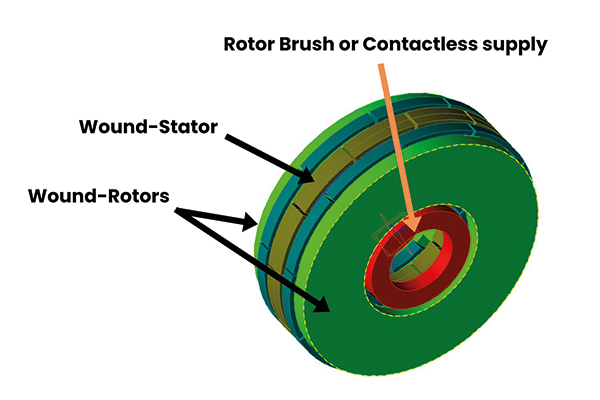
Figure 2: YEESMA Technology
Development Methodology
YEESMA developed their own FEA & Optimization models to reduce development time while still keeping “Digital-Twin” approach: Define at best all requirements’ details, from Performances outputs through Environment Specifications, like e.g. Air Cooling requirements for a 2-Wheelers or Oil-cooling specifications for a Truck Application. Our Approach heavily relies on conducting thorough Simulation Analysis before building Hardware parts. Such optimization process through a 3D-FEA Electromagnetic analysis is shown hereafter:
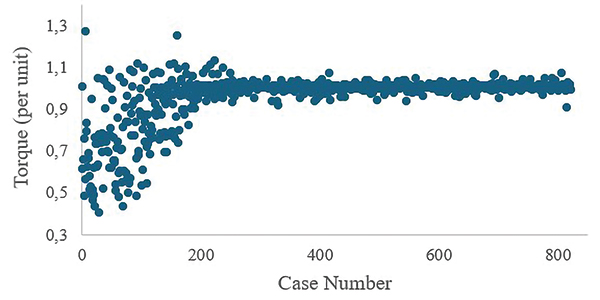
Figure 3: Optimization Process
The genetic algorithm progressively concentrates the population of candidate designs in the performance-optimal region of the search space.
Case Studies Results
Several Case Studies were conducted following same “Digital Twin” process. For simplicity and confidentiality reasons, only 4 cases studies are presented here.
For each case, we used CO2 footprint as a Sustainably Quantifier. This is done through summing up for each design material amount (active parts only), mostly Steel, Copper or Aluminum, and rare-earth permanent magnets for Benchmarks solutions.
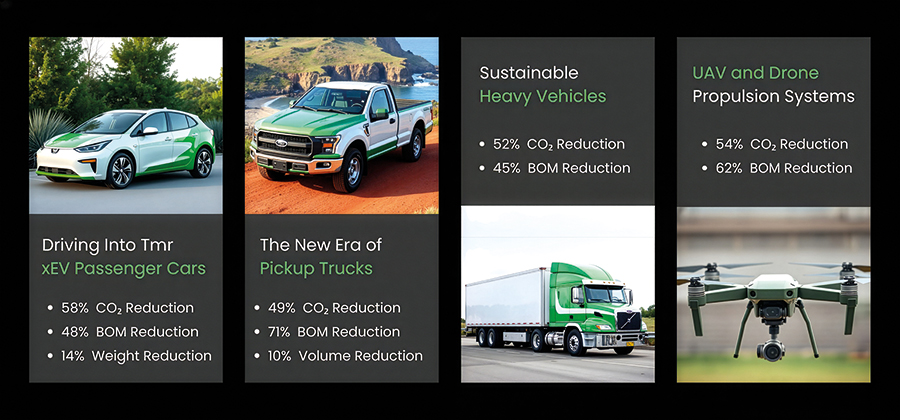
Figure 4: YEESMA Case Studies Results
Proof Of Concept Experimental Results
To further validate all our design tools, YEESMA designed, built and tested its own Proof Of Concept Hardware [1] – [2]. This has been done through the Department of Engineering “Enzo Ferrari”, University of Modena and Reggio Emilia (Italy).
Picture hereafter shows (manually) wound rotor.
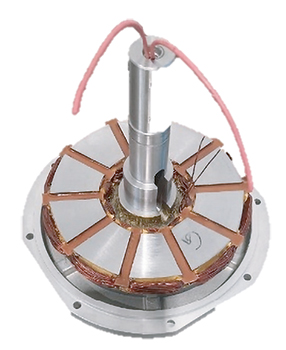
Figure 5: YEESMA Wound-Rotor
Whole tests were conducted on a dynamometer setup, with an external drive capable to provide both Stator Armature AC currents and Rotor field DC current.
Thorough analysis was done at first at no-load comparing theoretical BACK-EMF and measured voltages at various excitations levels. Exceptional confirmation was obtained through the whole excitation current range. Figure below measured data at 2000 rpm and 6.0A (considered as nominal excitation current)
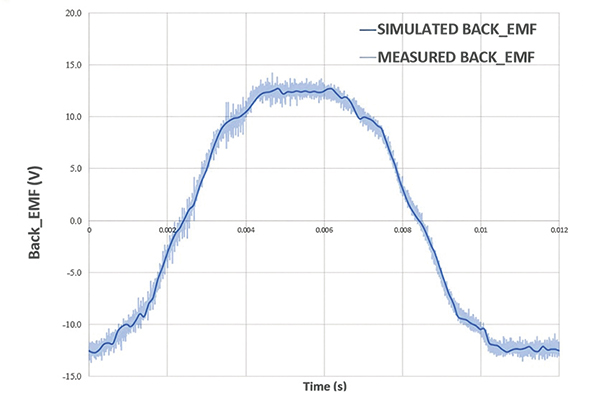
Figure 6: Comparison between Measured and Simulated Back-EMF
Load-tests focused first in the Continuous Torque/Speed area and shows as well very good fit between FEA Simulation and Experimental Results. Less than 5 % difference can be reported up to 1.6 times Maximum Continuous Torque
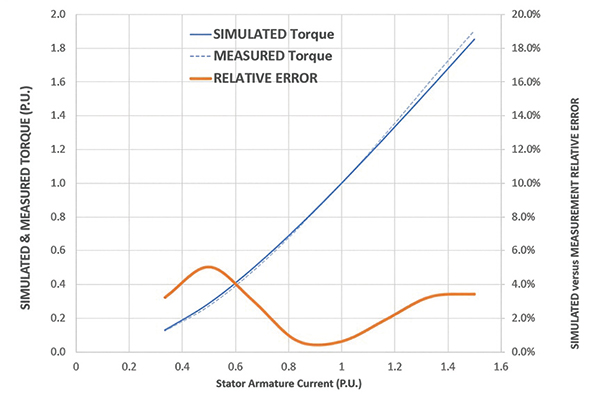
Figure 7: Comparison between Measured and Simulated Torque
Conclusion
This study has presented the Yokeless Electrically Excited Synchronous Machine (YEESMA) as a viable, high-performance, and sustainable alternative to conventional rare-earth permanent magnet machines. By eliminating the need for rare-earth materials and transitioning from a radial flux to an axial flux configuration, the YEESMA topology achieves significant reductions in copper usage, weight, and raw material demand, while maintaining competitive torque and power density. In addition, the proposed design achieved close to unity-power factor, it significantly reduces Inverter current demands and participates to the Overall Cost reduction.
Further development work will focus on the Manufacturing axis with Production-intend designs developed with an Industrial Partner.
References
[1] V. Mangeruga, A. Piergiacomi, S. Nategh, P. Farah and S. Nuzzo, „Structural Investigations on Yokeless Electrically-Excited Segmented Armature Axial Flux Motor,“ 2025 IEEE Workshop on Electrical Machines Design, Control and Diagnosis(WEMDCD), Valletta, Malta, 2025, pp. 1 – 6
[2] Design Optimization and Experimental Validation of an Innovative and Sustainable Electric Machine Topology,“ in IEEE Transactions on Transportation Electrification, Oct. 2025. (Submitted)