
Rory Brogan, Founder & CEO, Torev Motors
Torev Motors develops wound rotor axial flux motors for automotive and defense vehicles.
Building on proven, scalable technologies
Torev’s architecture builds on technologies already proven in production vehicles, including wound rotor motors used by companies including BMW and Nissan, and axial flux used by companies including Mercedes and Ferrari. By integrating these approaches, Torev aims to deliver motors capable of up to 2x the torque density of radial flux motors, that use 0 kg of permanent magnetic material, and that saves up to an estimated 50% on active material costs.
1.1 How it Works & Performance
Wound rotor motors, also called externally excited motors, replace permanent magnets with electrically excited coils. These motors offer greater torque and almost constant power at high speeds [1], wide efficiency maps stemming from direct control over the rotor fields, and material cost efficiencies from using no permanent magnets. Historically, these systems introduced greater weight, rotor thermal cooling requirements, and additional control complexity and cost stemming from the rotor energizing current, which modern designs are increasingly addressed through improved cooling strategies and power electronics. While brushed operation is traditionally the most common, modern brushes can last a vehicle’s lifetime and wireless power transfer methods are gaining in popularity.
Axial flux motors, also called pancake motors, take advantage of a shorter magnetic flux path that runs parallel to the axis of rotation, a cubic relationship between torque and motor diameter, and a greater magnetic interaction surface area to increase power and torque density along with efficiency [2]. This makes axial flux motors strong contenders for hybrid vehicle range extender and in-wheel drive applications. However, these very high-performance machines generally come with an equally high price tag arising from a combination of air gap control complexity in manufacturing, the use of materials like carbon fiber for structural integrity and lightweighting, and use of rare earth permanent magnets.
These architectures, when combined, enable Torev to develop magnetfree oil-cooled motors anticipated to produce peak torque and power densities of 15 Nm/kg and 3.5 kW/kg, and peak efficiencies upwards of 96% for their 180 kW 800 V flagship motor unit. These motors have an expected envelope of 370 mm OD x 225 mm Length.
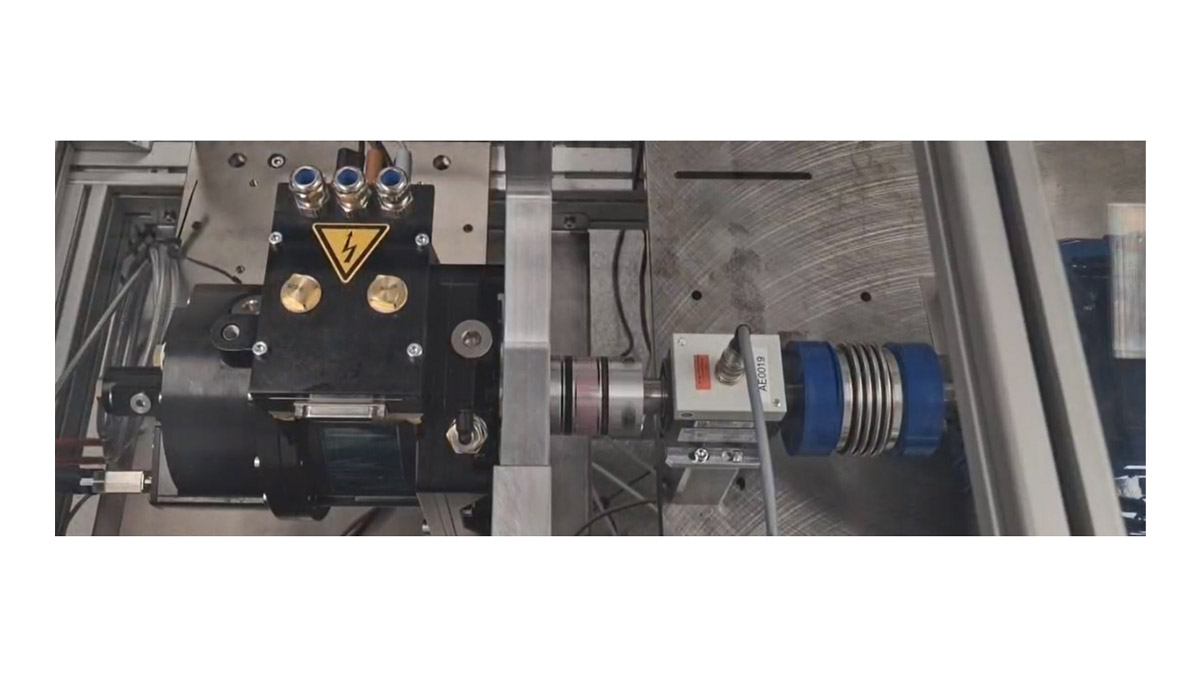
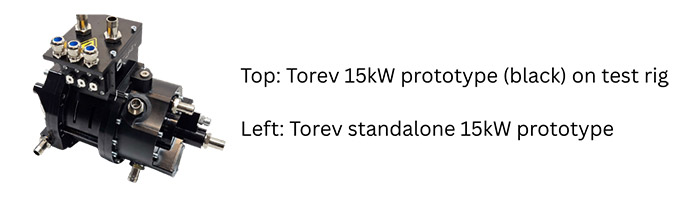
This product is TRL 4 and has been tested and validated by 3rd party motor testing firms, with a 15kW sub-scale prototype in operation and the 180 kW units expected to be ready for customer validation testing in the next 12 months.
1.2 Applications & Opportunities
Key advantages of this technology include direct control over the rotor field windings, the use of no permanent magnets, and the axial flux architecture. The rotor field is directly controlled, enabling an additional degree of system-level powertrain design freedom, the ability to fully demagnetize the rotor fields, and full motor programmability suitable for software defined vehicle architectures. No permanent magnets means both cost savings and no thermal demagnetization risk, the peak temperature of the motor is instead defined by the insulation class. The axial flux geometry fits naturally into a hybrid vehicle’s bell housing and also enables direct drive optionality as these motors generally perform strongly at speeds matched to that of an ICE crankshaft.
References
[1] Schaeffler. Magnet-free axle drive EESM. https://www.schaeffler.de/en/products-and-solutions/e-mobility/magnet-free-axle-drive-eesm
[2] E-Mobility Engineering. (2021, May 17). Power and torque density. https://www.emobility-engineering.com/challenge-of-power-torque-density.