
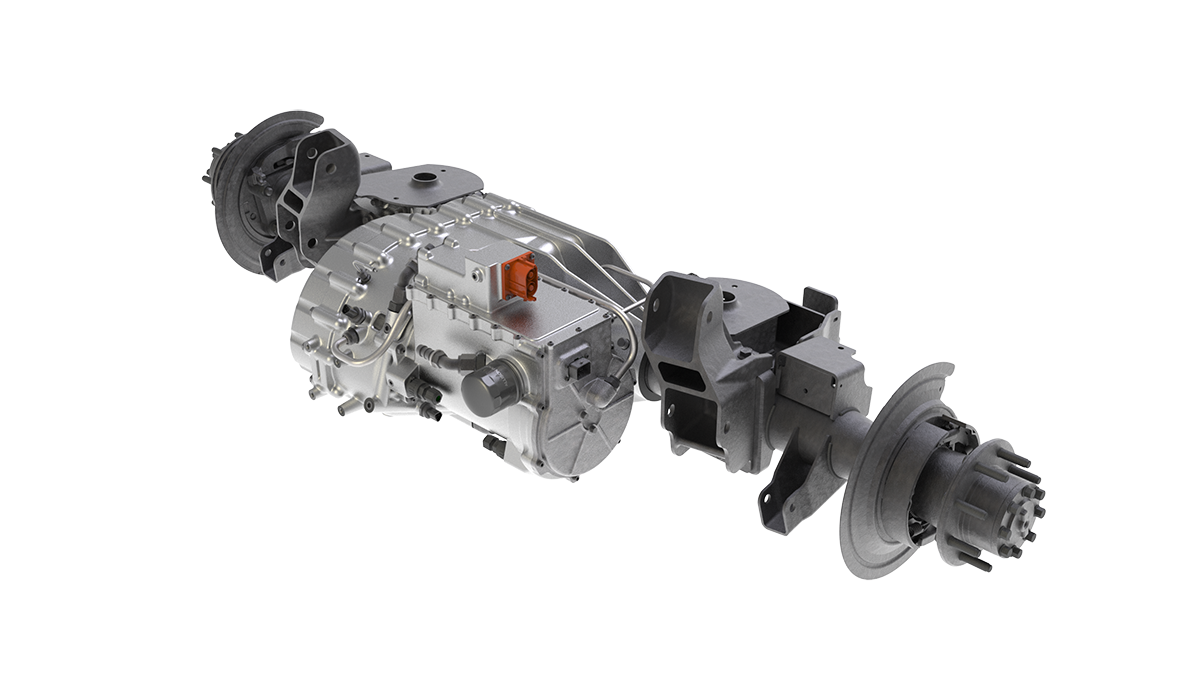
How a 2-speed integrated e-Beam axle removes the final barrier to practical heavy-duty electrification
Dan Ouwenga, Director – Product Management, Dauch
The promise of electric propulsion has always been straightforward: instant torque, smooth drivability, reduced NVH, and lower lifetime operating costs. For light-duty passenger vehicles, that promise has largely been delivered. But for the heavy-duty pickup truck – the Class 2b and Class 3 work vehicles that North American customers depend on to tow, haul, and perform under sustained load – first-generation electric architectures have fallen meaningfully short.
The technical challenge is the absence of a propulsion solution that can simultaneously deliver the launch torque, continuous power, and thermal robustness that HD truck customers require. A single-speed electric drive unit, however well-engineered, faces an inherent constraint: optimizing for peak launch torque forces a tradeoff against motor speed, mass, and efficiency at cruising conditions. The result is a system that can feel impressive off the line but struggles under sustained towing load which is precisely the use case that defines this segment.
Dauch’s HD 2-speed electric rear e-Beam was developed specifically to address that tradeoff. The architecture integrates a nested 2-speed planetary differential within the axle housing that enables low-range torque multiplication without placing additional torque loads on the upstream components. In low range, the system delivers between 16,000 and 25,000 Nm of wheel torque against a gear ratio exceeding 35:1 – numbers that comfortably exceed the demands of the most aggressive HD towing and gradeability cycles. In high range, the system transitions seamlessly to a configuration optimized for efficiency and highway operation, with the motor running in its peak efficiency zone.
The 2-speed design also enables the use of a smaller, lighter, highspeed induction motor – reducing diameter from a typical 230–260 mm down to 180 mm – which saves mass, improves packaging, and eliminates the supply chain and demagnetization risks associated with rare earth permanent magnet alternatives. A new flooded stator cooling system, using an integrated air gap sleeve to direct oil flow uniformly across the Copper windings, enables sustained motor output at more than double the current density of conventional cooling approaches. The result is continuous rated power above 225 kW – not a peak figure, but a sustained capability this single e-Beam axle can maintain through a full Davis Dam or Baker Grade simulation without thermal derating.
The inverter also benefits from innovative cooling technology. A folded fin heat sink design allows direct oil cooling of the silicon carbide switching devices, reducing junction temperatures and improving continuous current capability. Benchmarked against competing architectures, this configuration delivers more than 50% improvement over a conventional isolated back plate module – meaning equivalent continuous power with significantly less silicon area, reducing cost while improving thermal margin.
Real-world validation has confirmed what the simulations predicted. A prototype 2-speed HD e-Beam was integrated into a RAM Heavy-Duty BEV conversion vehicle and subjected to a full validation program spanning dynamometer testing, cold weather operation at Aumovio’s Brimley, Michigan development center, and hot weather SAE J2807 trailer tow simulation at the General Motors Yuma Desert Proving Ground in ambient temperatures exceeding 100°F. The vehicle successfully completed J2807 grade requirements at 26,000 lbs gross combined weight rating in two-wheel-drive – a demanding threshold that no comparable production-ready electric rear axle has achieved.
Thermal data captured during Davis Dam simulation at 45 mph in low range showed a 14–18% reduction in EDU operating temperatures compared to high range operation at the same load. That margin is not incidental – lower thermal load directly enables higher continuous power, longer towing duration, and greater calibration headroom. OEM customers present during vehicle demonstrations described the shift behavior as smooth and comparable to a traditional automatic transmission.
The technology is protected by a portfolio of 13 issued and pending patents, including two developed specifically for this application. Third-party freedom-to-operate searches have identified no blocking patents.
What this body of work ultimately demonstrates is that propulsion readiness can be removed from the list of barriers to HD electrification. The technical constraints that have prevented practical BEV and EREV adoption in the heavy-duty pickup segment – launch torque, thermal robustness under sustained load, production-viable shift quality – have been resolved. The remaining variables are market timing, energy storage and infrastructure solution readiness, and OEM program pacing. Those are real constraints, but they are external to the propulsion system. When the market conditions are right, Dauch is ready to provide an electrified HD solution.